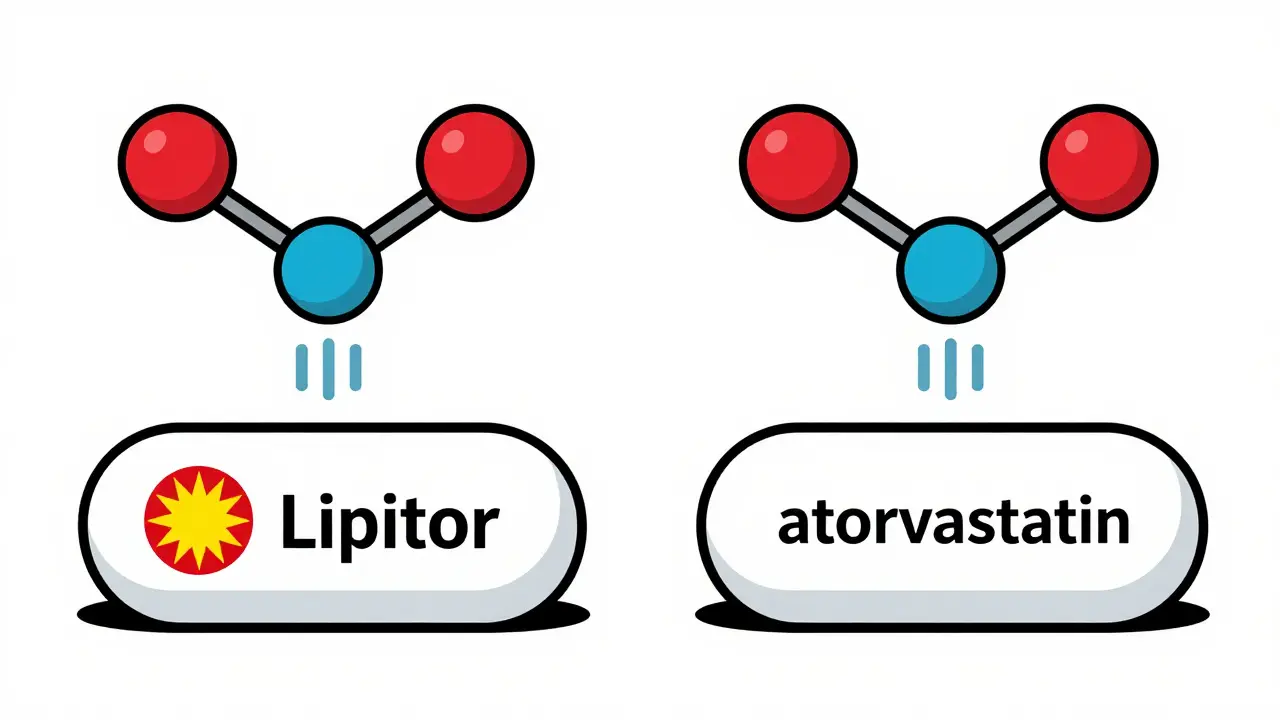

When you pick up a prescription, you might see two versions on the shelf: one with a flashy name like Lipitor, and another labeled simply as atorvastatin. The second one is a generic drug. It’s not a cheaper copy. It’s not a lesser version. It’s the exact same medicine - same active ingredient, same effect, same safety profile - but it costs up to 85% less.
What Exactly Is a Generic Drug?
A generic drug is a pharmaceutical product that contains the same active ingredient as a brand-name drug, in the same strength, dosage form, and route of administration. It works the same way in your body. It treats the same condition. It has the same risks and benefits. The only differences are in the inactive ingredients - things like color, shape, or flavor - and the price. The U.S. Food and Drug Administration (FDA) defines generic drugs as "identical or bioequivalent" to their brand-name counterparts. That means they must deliver the same amount of medicine into your bloodstream at the same rate. No more, no less. This isn’t a suggestion. It’s a legal requirement. Generic drugs become available only after the original brand-name drug’s patent expires. Most patents last 20 years from the date they’re filed. Once that window closes, other manufacturers can apply to produce the same drug under its chemical name. This system was created by the Hatch-Waxman Act of 1984, which gave the FDA a faster, cheaper way to approve generics without forcing companies to repeat expensive clinical trials.How Do Generic Drugs Prove They Work the Same?
The biggest question people have is: "If they didn’t do the same studies, how do we know they’re safe and effective?" The answer lies in bioequivalence testing. Before a generic drug can be approved, manufacturers must prove it behaves the same way in the human body as the brand-name version. They do this by giving the drug to 24-36 healthy volunteers and measuring how quickly and how much of the active ingredient enters the bloodstream. The key numbers are AUC (area under the curve) and Cmax (peak concentration). For the generic to be approved, these values must fall within 80% to 125% of the brand-name drug’s results. That’s a tight range - tighter than the variation allowed between different batches of the same brand-name drug. The FDA doesn’t accept theoretical claims. They require real-world data from real people. And they inspect every manufacturing facility - both in the U.S. and abroad - to make sure the drug is made under the same strict quality standards as brand-name products. In fact, the FDA inspects more than 3,500 generic drug plants each year. Many of these are the same factories that make the original brand-name versions.Why Are Generic Drugs So Much Cheaper?
The price difference isn’t because generics are lower quality. It’s because they don’t carry the same costs. Developing a new brand-name drug can cost over $2.6 billion. That includes decades of research, animal testing, multiple phases of clinical trials, marketing, and patent protection. Generic manufacturers don’t have to repeat any of that. They only need to prove bioequivalence and show they can make the drug consistently and safely. That cuts their development costs by more than 90%. Once multiple generic companies enter the market, prices drop even further. When five or more manufacturers sell the same generic drug, the price often falls to just 9% of the original brand price. In 2022, generic drugs made up 90.5% of all prescriptions filled in the U.S., but only 13.1% of total drug spending. Over the past decade, they’ve saved the American healthcare system more than $2 trillion.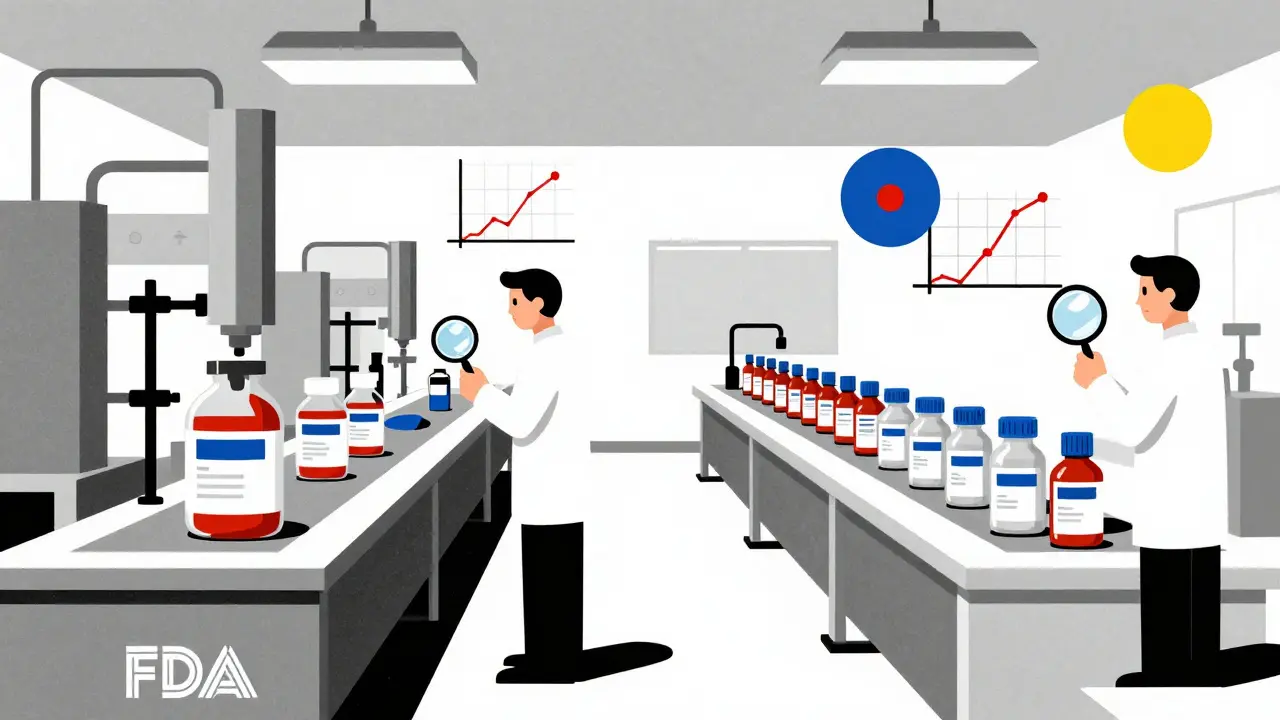
Are Generic Drugs as Safe as Brand-Name Drugs?
Yes. And the evidence is overwhelming. The Institute of Medicine reviewed 38 clinical studies on generic cardiovascular drugs and found no meaningful difference in effectiveness or safety compared to brand-name versions. The American College of Physicians, the American Medical Association, and the FDA all state clearly: generic drugs are therapeutically equivalent. Dr. Janet Woodcock, former head of the FDA’s drug review division, said it plainly: "The FDA would not allow generics to be marketed unless they were therapeutically equivalent to the brand." There are rare exceptions. For drugs with a narrow therapeutic index - meaning the difference between an effective dose and a harmful one is very small - switching between brands can sometimes cause issues. Examples include warfarin (a blood thinner), levothyroxine (for thyroid disorders), and some anti-seizure medications. In these cases, doctors may recommend sticking with one version, brand or generic, to avoid small variations in blood levels. But even then, the problem isn’t that generics are unsafe. It’s that even tiny differences matter more in these specific cases.What About the Looks? Why Do They Look Different?
Generic drugs often look different because U.S. law requires them to be visually distinct from brand-name drugs. That’s to avoid trademark infringement. So if your brand-name pill is a blue oval, the generic might be a white round tablet. The active ingredient? Identical. The effect? Identical. Sometimes, the generic version has a different flavor - especially for liquid or chewable forms. That’s because the inactive ingredients (excipients) can vary. But these don’t affect how the drug works. They’re just there to help with swallowing, stability, or appearance. Pharmacists are trained to explain these differences. If you’re confused by a new-looking pill, ask them. Don’t assume it’s not the right medicine.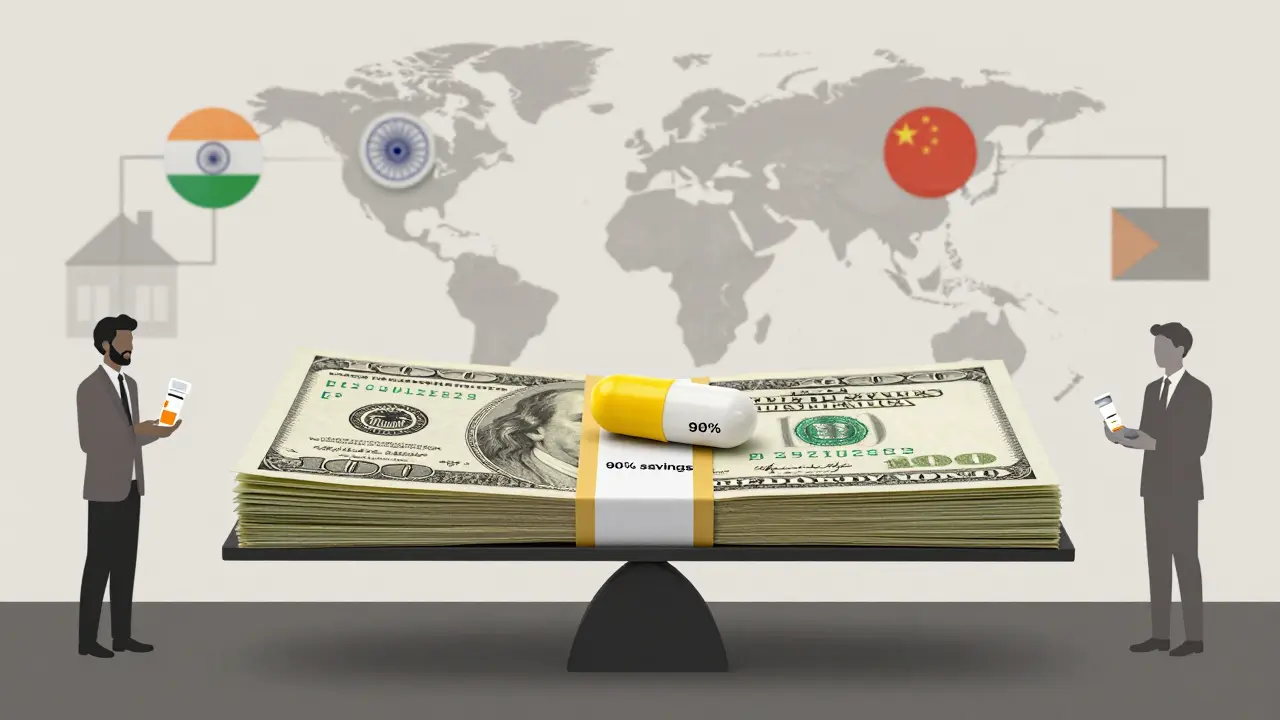
How Are Generic Drugs Regulated Around the World?
The FDA’s standards are among the strictest in the world. But other countries have similar rules. The European Medicines Agency, Health Canada, the UK’s MHRA, and Australia’s TGA all require bioequivalence and cGMP compliance for generics. The global generic drug market was worth $404 billion in 2022 and is expected to grow to nearly $570 billion by 2028. India and China supply about 80% of the active ingredients used in generic drugs worldwide. That’s efficient - but it also creates supply chain risks. When a factory in one country shuts down for inspection or quality issues, it can cause shortages globally. The FDA has increased inspections in these regions and is pushing for more transparency. In 2022, the agency issued 37 new product-specific guidelines for complex generics like inhalers, eye drops, and topical creams - areas where bioequivalence is harder to prove.What’s Next for Generic Drugs?
Between 2023 and 2027, 350 brand-name drugs with combined annual sales of $138 billion will lose patent protection. That’s a huge wave of new generic opportunities. But it’s not all straightforward. Some drugs, especially biologics - like insulin or rheumatoid arthritis treatments - are too complex to copy exactly. Instead, manufacturers create "biosimilars," which are highly similar but not identical. These cost less than brand-name biologics, but only by 20-30%, not 80-85%. Also, some brand-name companies now make their own generic versions - called "authorized generics" - to keep market share. These are identical to the brand but sold under a different label at a lower price. The FDA’s latest user fee program, GDUFA III, aims to cut review times for generic applications to 10 months for 90% of cases. That means faster access to affordable medicines.What Should You Do?
If your doctor prescribes a brand-name drug, ask if a generic is available. It’s almost always an option. In 49 U.S. states, pharmacists can automatically substitute a generic unless the doctor writes "dispense as written." Don’t assume a higher price means better quality. Don’t avoid generics because they look different. And don’t let fear of the unknown stop you from saving money - sometimes hundreds or even thousands of dollars a year. Generic drugs aren’t a compromise. They’re the smart, safe, and proven way to get the same treatment at a fraction of the cost. For millions of people, they’re the difference between taking medicine regularly and skipping doses because they can’t afford it.Are generic drugs really as effective as brand-name drugs?
Yes. The FDA requires generic drugs to have the same active ingredient, strength, dosage form, and bioequivalence as the brand-name version. They must deliver the same amount of medicine into your bloodstream at the same rate. Over 30 years of data and dozens of clinical studies show no meaningful difference in effectiveness or safety for most medications.
Why do generic drugs look different from brand-name drugs?
U.S. law requires generic drugs to look different to avoid trademark violations. That means different colors, shapes, or sizes. But the active ingredient and how it works in your body are identical. The differences are only in inactive ingredients like dyes or fillers, which don’t affect the drug’s performance.
Are generic drugs made in the same facilities as brand-name drugs?
Yes, often. Many generic drugs are made in the same factories as brand-name versions. The FDA inspects all facilities - whether they make brand or generic drugs - using the same strict standards. In fact, over half of all generic drugs in the U.S. are made by companies that also produce brand-name drugs.
Can I switch between brand-name and generic drugs safely?
For most medications, yes. But for drugs with a narrow therapeutic index - like warfarin, levothyroxine, or certain epilepsy medications - even small changes in blood levels can matter. In those cases, your doctor may recommend sticking with one version. Always talk to your doctor or pharmacist before switching.
Why are generic drugs cheaper if they’re the same?
Brand-name drug companies spend billions on research, clinical trials, and marketing. Generic manufacturers don’t have to repeat those expensive studies. They only need to prove their version works the same way. That cuts their costs dramatically - which is why generics cost 80-85% less on average.
Do generic drugs expire faster than brand-name drugs?
No. Generic drugs must pass the same stability tests as brand-name drugs to prove they last just as long. The FDA requires them to remain effective and safe for the same shelf life as the original product - typically 2-5 years, depending on the drug.


