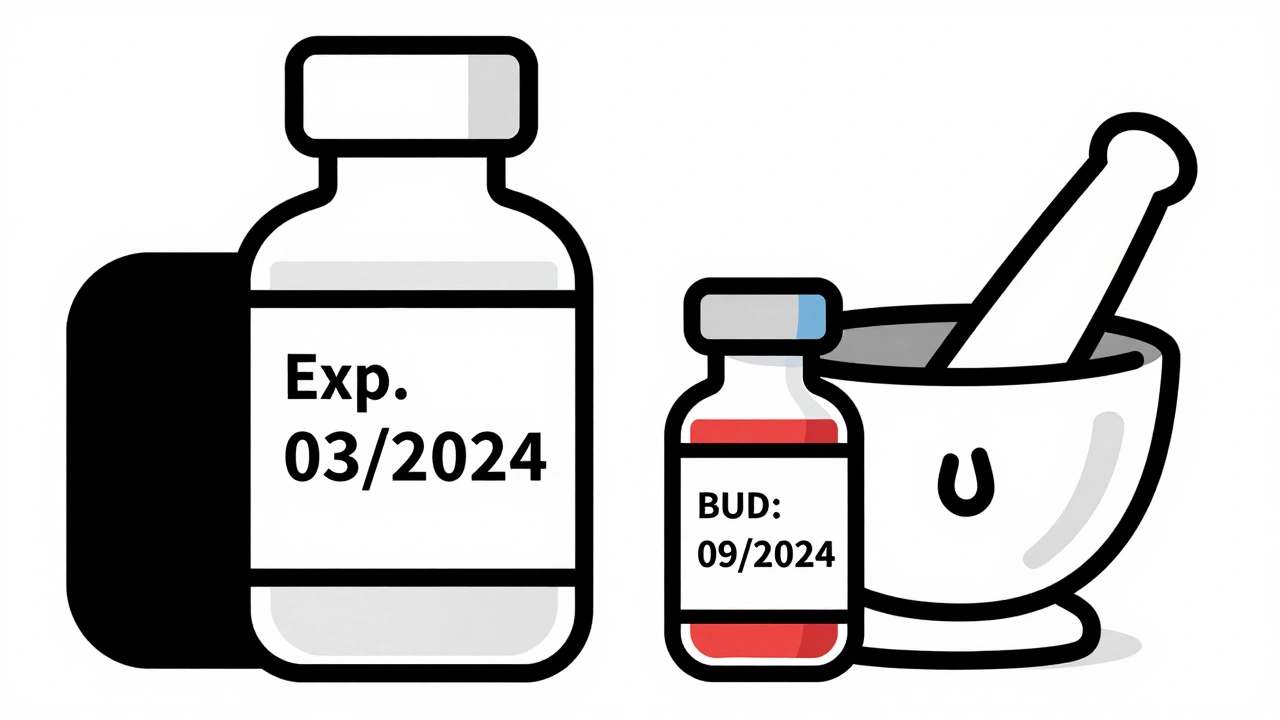

Ever opened a medicine bottle and seen two different dates? One says "Exp. 03/2024" - that’s the manufacturer’s expiration date. The other says "BUD: 09/2024" - that’s the beyond-use date from the pharmacy. They’re not the same. And mixing them up could mean taking a pill that doesn’t work - or worse, one that’s unsafe.
What’s the Difference Between Expiration Dates and Beyond-Use Dates?
Expiration dates come from the drugmaker. They’re the date the company guarantees your medicine will still work as intended, if stored properly. These dates are based on years of lab testing. The manufacturer puts the drug through heat, light, humidity, and time to see how it holds up. Only after proving it stays at least 90% potent do they set the expiration date.
Beyond-use dates (BUDs) are different. They’re set by the pharmacy - not the drugmaker. These dates apply when a medication is changed in any way: mixed into a liquid, repackaged into a different container, or compounded for a specific patient. Think of it like baking a cake from scratch versus buying one from the store. The store cake has a printed sell-by date. The homemade one? You guess how long it’ll last based on the ingredients and how you stored it.
The FDA requires expiration dates on all commercial drugs sold in the U.S. But BUDs? Those come from the United States Pharmacopeia (USP), and state pharmacy boards enforce them. If your pill was made in a lab by Pfizer, it has an expiration date. If your pharmacist ground it up and mixed it with flavoring for your child who can’t swallow pills, it has a BUD.
How Long Do Each of These Dates Last?
Expiration dates usually last between one and five years - sometimes longer. Most prescription pills are good for 24 to 60 months from when they were made. Over-the-counter drugs like ibuprofen or acetaminophen often last even longer. The FDA has tested hundreds of drugs past their expiration dates and found many still work fine - even 10 to 15 years later - if stored in a cool, dry place.
But BUDs? They’re short. Why? Because compounded medications don’t have the same stabilizers, preservatives, or sealed packaging that factory-made drugs do. A simple oral liquid made from a crushed tablet might only last 14 days in the fridge. A cream mixed with a hormone might last 45 days at room temperature. Solid pills compounded from powder can go up to 180 days - but only if kept dry and cool.
Here’s a quick reference:
| Medication Type | Date Type | Typical Duration | Storage Requirement |
|---|---|---|---|
| Commercial prescription pill | Expiration Date | 1-5 years | Room temperature, dry |
| Repackaged pill (pharmacy) | Beyond-Use Date | Up to 1 year or original expiration - whichever comes first | Same as original |
| Compounded liquid (e.g., thyroid medicine) | Beyond-Use Date | 14-30 days | Refrigerated |
| Compounded cream (e.g., hormone cream) | Beyond-Use Date | 30-90 days | Room temperature |
| Compounded powder (e.g., allergy medication) | Beyond-Use Date | Up to 180 days | Dark, dry place |
Why Can’t You Just Use the Expiration Date on a Compounded Drug?
Imagine you take a bottle of amoxicillin from the pharmacy. It says "Exp. 12/2025." You open it, pour the powder into a blender, mix it with cherry syrup, and bottle it for your 5-year-old. Now you’ve changed it. The original stability data? Irrelevant. The plastic bottle you used? Not the same as the manufacturer’s sealed container. The syrup you added? Might react with the antibiotic.
That’s why the expiration date disappears the moment a pharmacist alters the drug. The manufacturer never tested it this way. So the pharmacist has to guess - based on USP guidelines - how long it’ll stay safe and effective. That’s the BUD. And it’s always shorter.
Even repackaging matters. If your pharmacy takes 100 pills from a big bottle and puts them into a child’s pill organizer, that organizer now has a BUD - not the original expiration date. Why? Because light, air, and moisture can get in. The pills might still be good, but no one can guarantee it anymore.

What Happens If You Use Medicine After the Date?
Most expired drugs won’t hurt you. But they might not work.
Antibiotics like amoxicillin or doxycycline can lose potency. If you’re taking them for an infection, you might not kill all the bacteria. That can lead to resistant strains - a real public health risk.
Insulin? Epinephrine? Heart medications? These are different. If insulin loses potency, your blood sugar spikes. If an EpiPen doesn’t work during an allergic reaction, someone could die.
Compounded medications are even riskier. Without preservatives, they can grow mold or bacteria. A liquid thyroid medication left out for two months? It could be contaminated. A cream stored in a warm bathroom? It might separate or degrade into harmful compounds.
Studies show 68% of patients on compounded meds throw away unused portions because the BUD ran out before they finished their course. That’s not just expensive - it’s wasteful. But using it past the date? That’s dangerous.
How to Know Which Date to Follow
Always check both dates - and know which one applies.
- If the medicine came in its original sealed bottle from the manufacturer - follow the expiration date.
- If the pharmacy put it in a different container, mixed it, or made it from scratch - follow the beyond-use date.
- If you’re unsure, ask the pharmacist. They’re required to tell you which date to use.
Look at the label. Expiration dates are usually printed as "Exp. MM/YYYY" or "Exp. MM/DD/YYYY." BUDs are often labeled "BUD: MM/YYYY" or "Use by: MM/DD/YYYY." Some pharmacies use "Dispense Date + XX Days" - like "Disp. 01/15/2025, BUD: 03/15/2025."
Don’t assume. I’ve seen patients use a compounded cream past its BUD because the original bottle said it was good for another year. That’s how people get infections or failed treatments.

Storage Matters More Than You Think
Even the best date means nothing if you store the medicine wrong.
Commercial pills? Store them in a cool, dry place - not the bathroom. Humidity ruins them. Heat weakens them.
Compounded meds? Often need refrigeration - even if the original drug didn’t. Why? Because the pharmacy removed the preservatives to make it safer for sensitive patients. Without those, bacteria grow faster. A liquid antibiotic that’s supposed to last 14 days might spoil in 5 if left on the counter.
Keep compounded meds in their original dark bottles. Don’t transfer them to clear containers. Light breaks down many drugs. And never freeze unless the label says to. Freezing can change the chemical structure of some compounds.
What to Do With Old or Expired Medicine
Never flush pills down the toilet or toss them in the trash. That’s bad for the environment and risky if kids or pets get into it.
Most U.S. pharmacies - over 90% - offer free take-back programs. Bring your expired or past-BUD meds to the counter. They’ll dispose of them safely.
If your pharmacy doesn’t offer this, check with local police stations or hospital drop boxes. Many have secure collection bins. The DEA also runs National Prescription Drug Take Back Days twice a year.
And if you’re unsure whether a medicine is still good? When in doubt, throw it out. Better safe than sorry.
Why This Matters for You
More than 8 million Americans rely on compounded medications. Kids with allergies. Elderly patients who can’t swallow pills. People with rare conditions. These aren’t fringe cases - they’re real people needing real care.
But the system isn’t perfect. BUDs vary by state. Some pharmacies are sloppy. Patients get confused. And with the compounding market growing to $11.7 billion a year, the pressure to cut corners is real.
Knowing the difference between expiration dates and beyond-use dates isn’t just technical knowledge. It’s safety knowledge. It’s about making sure your medicine works when you need it - and doesn’t harm you when you don’t.
Next time you pick up a prescription, pause. Look at the label. Ask: Is this the original bottle? Did the pharmacy change it? What’s the real date I need to follow?
One extra minute of checking could save you money, time, and maybe even your health.
Can I use a medication after its expiration date if it looks and smells fine?
For commercial medications, some drugs may still be effective past their expiration date if stored properly - but the manufacturer no longer guarantees safety or potency. The FDA advises against using expired drugs because storage conditions at home (heat, humidity, light) can degrade them unpredictably. For compounded medications, never use past the beyond-use date - even if it looks fine. These lack preservatives and can harbor bacteria or mold without visible signs.
Why does my compounded medication have a shorter date than the original bottle?
When a pharmacy alters a medication - by mixing it, crushing it, or adding flavoring - it changes the chemical environment. The original expiration date was tested only on the manufacturer’s exact formulation in its sealed packaging. Once altered, those conditions no longer apply. The pharmacist assigns a beyond-use date based on USP guidelines, which are conservative to ensure safety. Even if the original pill was good for 3 years, the liquid version you got might only last 30 days.
Do I need to refrigerate all compounded medications?
Not all - but many do. Non-sterile compounded liquids, especially those with water or no preservatives, usually require refrigeration to prevent bacterial growth. Creams and ointments may not need it unless specified. Always follow the storage instructions on the label. If it says "refrigerate," keep it in the fridge - even if the original drug didn’t require it. The absence of stabilizers in compounded formulas makes them more sensitive to temperature.
Can I extend a beyond-use date if I haven’t used all the medicine?
No. Beyond-use dates are set by pharmacists based on strict USP guidelines and cannot be extended by patients. Unlike manufacturer expiration dates, which are based on scientific testing, BUDs are estimates made under controlled lab conditions - not real-world home storage. Extending them risks contamination, loss of potency, or chemical breakdown. If you have leftover compounded medication past its BUD, return it to the pharmacy for safe disposal.
What should I do if I accidentally take medicine past its date?
If you took a commercial medication past its expiration date and feel fine, you’re likely okay - but it may not have worked as intended. If you took a compounded medication past its BUD, especially a liquid or injectable, contact your pharmacist or doctor immediately. Watch for signs of illness like fever, rash, nausea, or worsening symptoms. Never assume it’s harmless. Compounded meds carry higher risks of contamination or degradation that aren’t visible or noticeable until it’s too late.


