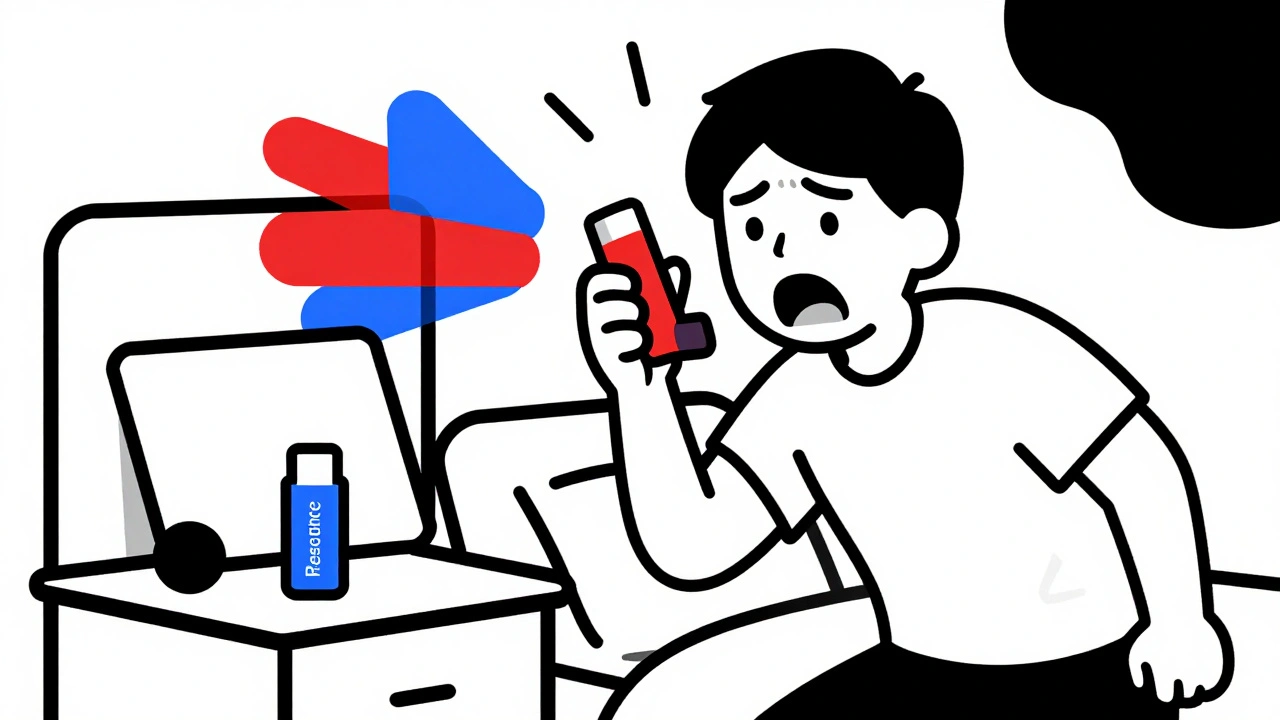

Every year, thousands of people end up in emergency rooms because they used the wrong inhaler. Not because they didn’t know they had asthma. Not because they forgot their medication. But because they grabbed the rescue inhaler when they needed the maintenance inhaler-or vice versa. It sounds simple. But in the heat of a breathing attack, when your chest is tight and your lungs feel like they’re shutting down, distinguishing between two small, similarly colored plastic devices isn’t easy. And that mistake can cost you precious minutes-maybe even your life.
What’s the Difference Between Rescue and Maintenance Inhalers?
These aren’t just two types of the same thing. They’re two completely different tools with opposite jobs.
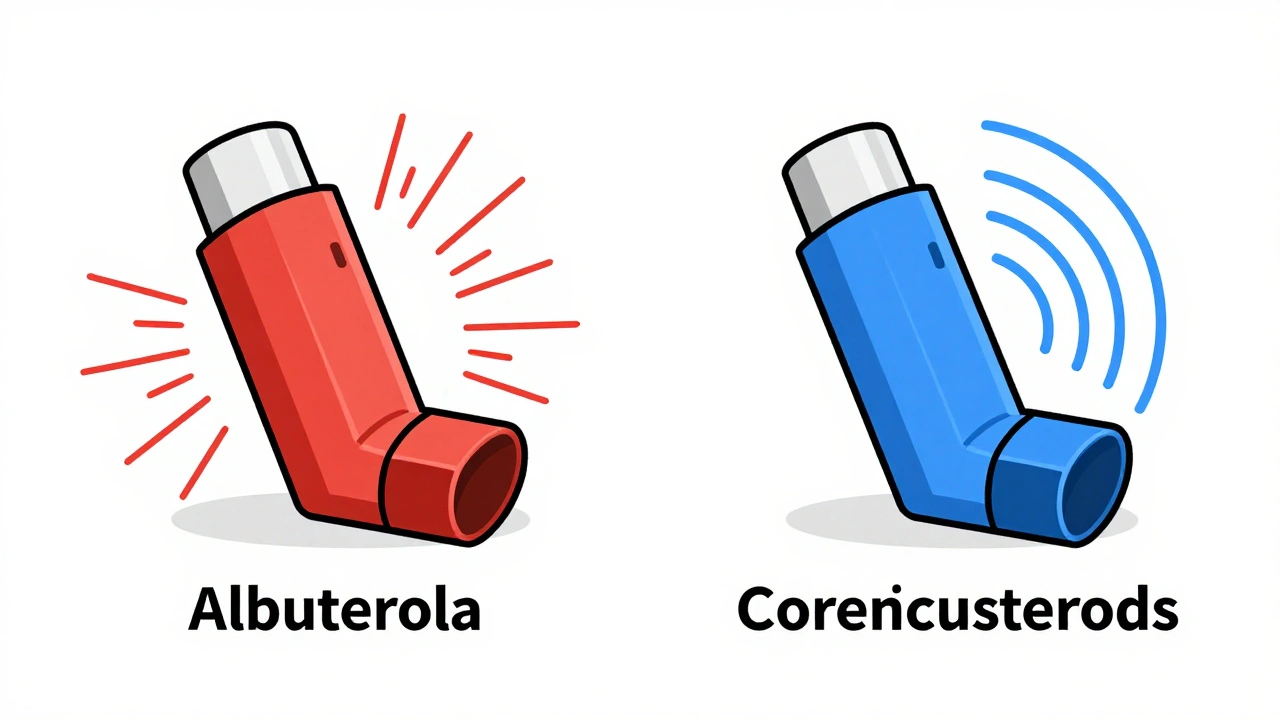
A rescue inhaler is your emergency tool. It’s what you use when you’re gasping for air, wheezing, or feeling like you can’t get enough oxygen. It works fast-within 1 to 5 minutes-to open up your airways. The active ingredient is almost always a short-acting beta agonist, like albuterol (found in Ventolin, ProAir, or Proventil) or levalbuterol (Xopenex). These drugs relax the muscles around your bronchial tubes, letting you breathe easier right away. But here’s the catch: they don’t touch the inflammation. They don’t fix the root problem. They just buy you time.
A maintenance inhaler is your daily shield. It’s not for emergencies. It’s for prevention. These contain inhaled corticosteroids like fluticasone or budesonide, sometimes paired with long-acting bronchodilators like formoterol or salmeterol. Their job is to calm the chronic swelling and mucus buildup in your airways so you don’t have attacks in the first place. But they don’t work fast. It takes 24 to 48 hours for them to start helping-and up to three weeks to reach full effect. If you use one during an attack, you’re wasting time. You’ll still be struggling while waiting for something that wasn’t built to help you now.
Why Mixing Them Up Can Be Deadly
There’s a reason the FDA now requires different colors on new inhalers. In 2022, over 1,200 reported cases involved people grabbing the wrong one. One case from a summer camp in 2023 involved a 9-year-old boy who grabbed his red Symbicort inhaler-designed for daily use-instead of his blue ProAir rescue inhaler. He waited 12 minutes while his breathing got worse. By the time he got the right one, he was in full respiratory distress. He ended up in the hospital.
This isn’t rare. A 2023 study by the American College of Allergy, Asthma & Immunology found that 38% of near-fatal asthma events involved people relying only on rescue inhalers, skipping their daily controller meds. They thought, “I’ll just use my rescue inhaler more often.” But using albuterol more than twice a week is a red flag-it means your asthma isn’t under control. And no amount of rescue inhaler use will stop your airways from slowly narrowing over time.
On the flip side, people who don’t need daily medication are often overprescribed maintenance inhalers. A 2022 European Respiratory Society study showed 27% of mild asthma patients were given daily corticosteroids when they only needed a rescue inhaler for occasional flare-ups. That’s unnecessary exposure to steroids, with no real benefit.
How to Tell Them Apart
Color isn’t foolproof-but it’s a start. In the UK and many US clinics, rescue inhalers are often red or orange, while maintenance inhalers are blue or purple. But colors aren’t standardized globally. The safest way? Always check the label.
- Rescue inhalers: Albuterol, levalbuterol, terbutaline. Labels say “for use as needed,” “for sudden symptoms,” or “short-acting.”
- Maintenance inhalers: Fluticasone, budesonide, mometasone, beclomethasone. Labels say “daily use,” “preventer,” or “controller.”
- Combination inhalers: Symbicort (budesonide + formoterol), Advair (fluticasone + salmeterol). These are trickier. Symbicort is approved for both maintenance and rescue in certain cases-but only if your doctor specifically told you to use it that way. Never assume.
Keep them in separate places. One by your bed, one in your bag. Use a pill organizer to track daily doses. Set phone reminders. If you’re a parent, teach your child the difference with a simple game: “Red = emergency. Blue = daily shield.”
How to Use Them Right
Even if you pick the right one, using it wrong makes it useless.
For a rescue inhaler:
- Shake well.
- Breathe out fully.
- Press the canister and breathe in slowly over 5 to 7 seconds.
- Hold your breath for 10 seconds.
- Wait 30 seconds before a second puff, if needed.
This technique gets 30-40% of the medicine into your lungs. Do it wrong-quick puff, no breath hold-and you’re lucky to get 10%. That’s like trying to put out a fire with a teaspoon of water.
For a maintenance inhaler:
- Shake.
- Breathe out.
- Press and breathe in slowly.
- Hold for 10 seconds.
- Rinse your mouth with water afterward. This prevents thrush-a fungal infection that can develop from inhaled steroids.
Missing just 3 doses a week (20% of your schedule) cuts effectiveness by 45%. That’s not laziness-it’s a medical risk. If you forget, set a daily alarm. Use a tracker app. Write it on your calendar. Your lungs don’t care if you’re busy. They only care if you show up.
When to Call Your Doctor
There are clear signs your asthma isn’t under control:
- Using your rescue inhaler more than twice a week (not counting exercise)
- Waking up at night because of wheezing or coughing
- Needing to refill your rescue inhaler every 2 months or less
- Having to cut back on activities because you’re afraid of an attack
If any of this sounds familiar, it’s not “just bad asthma.” It’s a signal your treatment plan needs an update. Most people assume they just need more rescue inhaler. But what they really need is better maintenance-or a different one.

The New Way: One Inhaler for Both Jobs
Here’s something surprising: the latest guidelines from GINA (Global Initiative for Asthma) now recommend a single-inhaler approach for many people. Instead of carrying two, you use one combination inhaler-like Symbicort-that contains both a steroid and a fast-acting bronchodilator.
This is called SMART therapy (Single Maintenance and Reliever Therapy). You use it every day to keep inflammation down, and if you feel an attack coming, you use it again-no need to switch devices. It reduces confusion, cuts down on medication errors, and has been shown to lower hospital visits by up to 30% in clinical trials.
It’s not for everyone. If you have severe asthma or are on high-dose steroids, your doctor may still recommend two separate inhalers. But for mild to moderate asthma, this is becoming the new standard. And by 2027, experts predict 60% of new asthma patients will start with this approach.
Cost and Access: The Hidden Barrier
Let’s be real: cost keeps people from using maintenance inhalers.
A generic rescue inhaler like ProAir HFA costs $35-$50 without insurance. A maintenance inhaler like Symbicort? $300-$350 a month. That’s why 42% of patients skip doses because of high copays, according to a 2024 Kaiser Family Foundation survey.
But here’s the math: skipping your maintenance inhaler leads to more ER visits, more missed work, more hospital stays. One asthma hospitalization can cost $5,000-$15,000. That’s more than a year’s worth of inhalers.
Ask your doctor about patient assistance programs. Many manufacturers offer free or low-cost options. Pharmacies like CVS and Walgreens have $4 generic maintenance inhalers. Don’t let price keep you from breathing easy.
What’s Next?
Researchers are working on faster-acting inhalers. The NIH is testing a new steroid inhaler that works in under 90 seconds-close to rescue speed but with long-term benefits. If it works, it could change everything.
For now, though, the best tool you have is knowledge. Know which inhaler does what. Know how to use it. Know when to call for help. And never, ever treat your rescue inhaler like your daily medicine.
Asthma doesn’t care how smart you are. It only cares if you’re prepared. And the right inhaler, at the right time, can mean the difference between a normal day-and a trip to the ER.
Can I use my maintenance inhaler if I don’t have my rescue inhaler during an attack?
No. Maintenance inhalers take hours to start working and won’t help during a sudden attack. If you don’t have your rescue inhaler, call emergency services immediately. Do not wait for your maintenance inhaler to work. Using it during an attack delays life-saving treatment and can lead to worsening symptoms.
How do I know if I’m using my inhaler correctly?
A simple test: after using your inhaler, you should feel the medicine go deep into your lungs-not just in your mouth or throat. If you taste the medicine strongly or get a sore throat, you’re probably not breathing in slowly enough. Ask your pharmacist or doctor to watch you use it. Many clinics offer free inhaler technique checks. Proper use doubles your medication’s effectiveness.
Is it safe to use a rescue inhaler every day?
Not long-term. Rescue inhalers like albuterol are designed for occasional use. Using them more than twice a week means your asthma isn’t controlled. Daily use can lead to tolerance, where the drug becomes less effective. It also masks worsening inflammation. If you’re relying on your rescue inhaler daily, talk to your doctor-you likely need a maintenance inhaler.
Why do some inhalers cost so much more than others?
Brand-name inhalers like Symbicort or Advair cost more because they’re combination drugs with patented ingredients. Generic rescue inhalers like albuterol are older, off-patent medications, so they’re cheaper. Maintenance inhalers often contain steroids, which are more expensive to produce. Insurance coverage varies widely. Ask your pharmacy about generic alternatives or patient assistance programs-they can cut your monthly cost by 80% or more.
Can children use the same inhalers as adults?
The same medications are used, but delivery methods differ. Young children often use inhalers with a spacer and mask, which helps them get the full dose. Rescue inhalers like albuterol are safe for kids. Maintenance inhalers are prescribed based on age and severity. Always follow your pediatrician’s instructions-never give a child an adult inhaler without proper guidance.
What happens if I stop using my maintenance inhaler?
Your airways will slowly become inflamed again. Within days, you may notice more coughing, wheezing, or shortness of breath. Over weeks, your risk of a severe attack increases dramatically. Stopping maintenance inhalers doesn’t make asthma go away-it just lets it get worse. Even if you feel fine, your lungs are still quietly inflamed. Consistent use is the only way to prevent that.


