

Imagine waking up one day and realizing you can’t walk like you used to. Your steps feel stuck, like your feet are glued to the floor. You forget where you put your keys. You start having accidents you never had before. You tell your doctor it’s just aging. But what if it’s not? What if it’s something treatable - something that could bring back your independence in weeks, not years?
This isn’t rare. It’s normal pressure hydrocephalus, or NPH. And it’s one of the few types of dementia that can be reversed with surgery.
What Is Normal Pressure Hydrocephalus?
NPH is a condition where too much cerebrospinal fluid (CSF) builds up in the brain’s ventricles. These are natural fluid-filled spaces that cushion the brain. In most people, CSF flows in and out smoothly. In NPH, it gets stuck. The pressure doesn’t spike like in acute hydrocephalus - that’s why it’s called “normal” pressure. But the fluid still swells the ventricles, squishing nearby brain tissue.
It mostly hits adults over 60. About 1 in 200 people over 65 have it, and in nursing homes, that number jumps to nearly 6 in 100. Yet most are never diagnosed. Why? Because its symptoms look exactly like Alzheimer’s, Parkinson’s, or just getting older.
The real clue? It’s not just memory loss. It’s the way you move.
The Three Signs: Gait, Cognition, and Bladder Control
NPH has a classic trio of symptoms - but you rarely get all three at once.
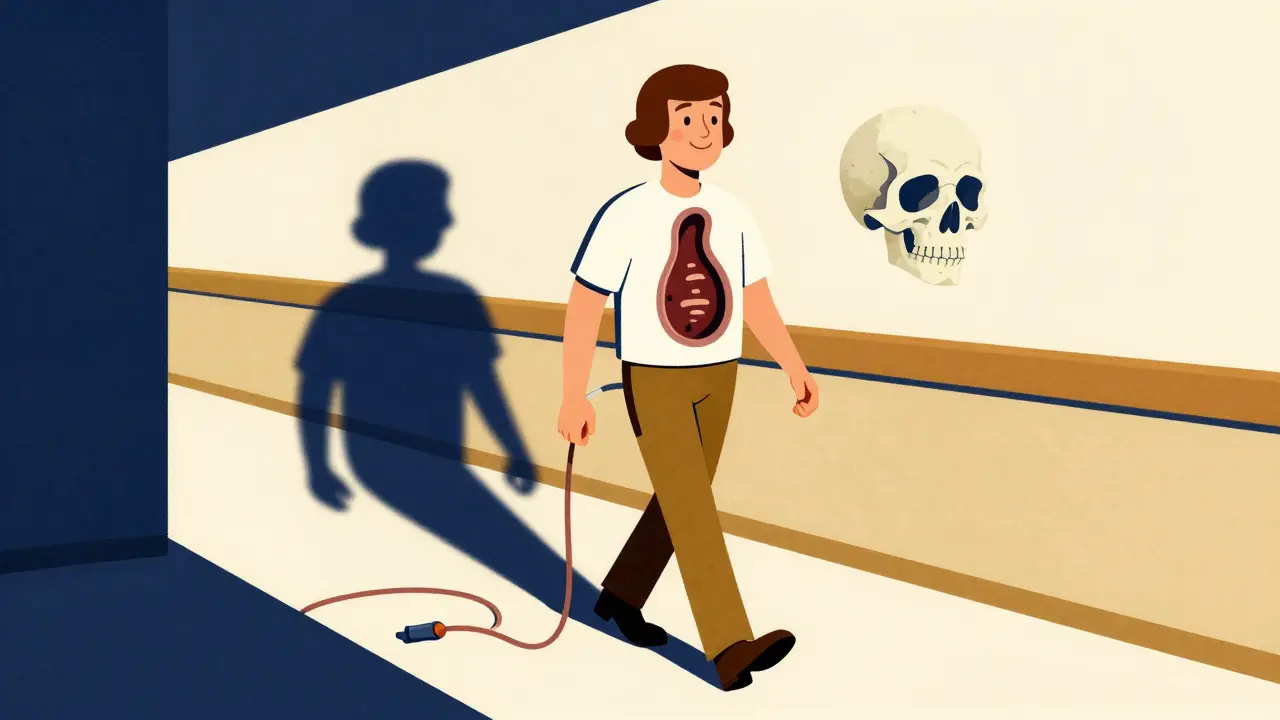
- Gait disturbance comes first - and it’s unmistakable. People describe it as a “magnetic walk.” Feet shuffle, steps are short, arms don’t swing. Turning is hard. You might feel like you’re walking on ice. In studies, 100% of confirmed NPH patients show this. It’s not weakness. It’s the brain’s motor signals getting muddled.
- Cognitive changes follow. Not the memory gaps of Alzheimer’s. Instead, it’s slow thinking, trouble planning, forgetting why you walked into a room, losing focus. Neuropsych tests show frontal lobe problems - the part that handles decision-making and attention. About 73% of patients show this.
- Urinary incontinence shows up later. Not always. Only about 1 in 3 people with NPH have it early on. But when it does, it’s often the last straw that pushes families to seek help.
Only about 1 in 3 patients have all three symptoms together. That’s why so many get misdiagnosed. A 72-year-old man with a shuffling walk and occasional forgetfulness? His doctor says “early dementia.” A 78-year-old woman with bladder issues and slower speech? “Just aging.” But NPH doesn’t wait. It creeps in - and it’s reversible.
How Do Doctors Diagnose It?
Diagnosing NPH is like solving a puzzle with missing pieces. No single test confirms it. You need a mix.
First, imaging. A CT scan or MRI shows enlarged ventricles. The key number? Evan’s index - the ratio of ventricle width to brain width. If it’s over 0.3, that’s a red flag. MRI also picks up swelling around the ventricles, a telltale sign of CSF buildup.
Then comes the CSF tap test. This is critical. A doctor removes 30 to 50 milliliters of spinal fluid with a needle - like a spinal tap. You’re measured before and after: how fast you walk 10 meters, how well you answer simple questions, whether you can hold it longer.
If your walking improves by 10% or more after the tap, your odds of benefiting from a shunt jump to 82%. If you improve by 15%, your chance of success is nearly 9 in 10. That’s not guesswork. That’s science.
Some centers use a longer test - external lumbar drainage over 3 to 5 days - to see if symptoms improve gradually. But the tap test is faster, cheaper, and just as predictive for most people.
And here’s the kicker: you need to rule out other causes. Parkinson’s? It usually starts with tremors. Alzheimer’s? Memory loss comes before movement problems. Vascular dementia? Symptoms jump after a stroke. NPH? The decline is slow, steady, and - crucially - reversible.
Shunt Surgery: The Treatment That Works
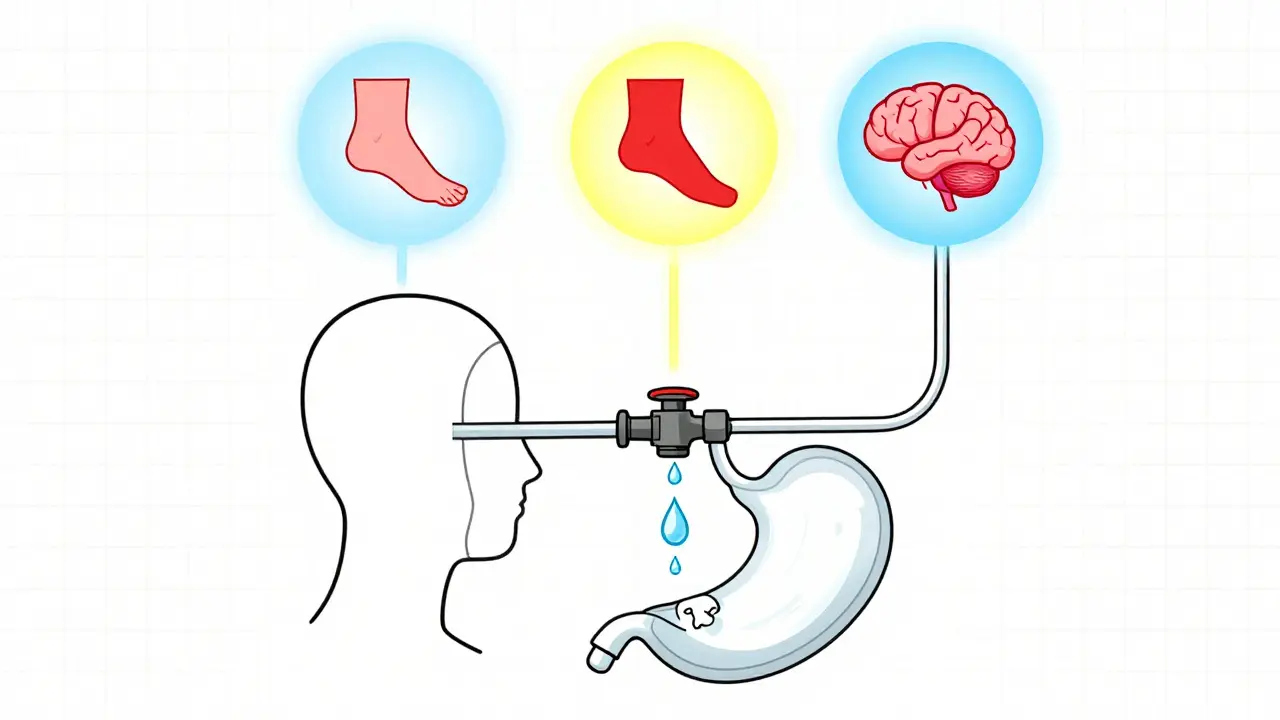
If the tap test works, surgery is the next step. The standard is a ventriculoperitoneal (VP) shunt. A thin tube is placed in the brain’s ventricle, threaded under the skin, and ends in the abdomen. A valve in between controls how much fluid drains - usually set between 50 and 200 mm H₂O. The body absorbs the fluid like it’s supposed to.
The surgery takes about an hour. You’re under general anesthesia. Most go home in 2 to 3 days. Recovery? 6 to 12 weeks. But the change? Sometimes it’s instant.
One man in Bristol, 72, told his neurosurgeon he hadn’t walked without a cane in two years. Two days after his shunt, he walked 10 meters in 12 seconds - down from 28. He stopped using incontinence pads within a week. “I felt like I got my life back,” he said.
Studies show 70 to 90% of properly selected patients improve. Gait gets better in 76%, cognition in 62%, bladder control in 58%. Most report a huge jump in quality of life - 28.5 points on a standard scale. Many stop needing help from caregivers.
But it’s not magic. About 20 to 30% of shunts don’t help. Why? Sometimes the diagnosis was wrong. Sometimes the brain has already changed too much. Sometimes the valve setting isn’t right. And sometimes, the patient has another condition - like Alzheimer’s - mixed in. That happens in a quarter of NPH cases.
What Can Go Wrong?
Shunts save lives - but they’re machines. And machines can break.
- Infection happens in about 8.5% of cases. Fever, redness along the tube, or confusion after surgery? That’s a red flag.
- Shunt malfunction is even more common - 15% within two years. The tube can clog, break, or move. Symptoms return: walking gets hard again, memory slips, bladder control fades.
- Subdural hematoma - bleeding between the brain and skull - occurs in 5.7% of cases. It’s serious but treatable if caught early.
Older patients - especially over 80 - have higher infection rates. That’s why doctors weigh risks carefully. But for most, the benefit outweighs the risk. A 2023 study showed that people who got shunts lived longer and stayed independent longer than those who didn’t.
Some need revisions. About 32% of patients have at least one shunt adjustment or replacement. That’s not failure - it’s maintenance. Like changing a pacemaker battery.
Why Is NPH So Often Missed?
It takes an average of 14 months from first symptoms to diagnosis. Why so long?
Primary care doctors rarely test for it. Gait problems? “He’s just old.” Memory lapses? “She’s getting dementia.” Bladder issues? “That’s common after 70.”
Insurance doesn’t help. In the U.S., nearly 4 out of 10 CSF tap tests get denied before approval. People wait months for authorization. By then, the window for best results closes.
And then there’s the stigma. “Dementia is permanent,” people say. But NPH isn’t. It’s the great masquerader - hidden in plain sight.
Neurologist Dr. Norman Relkin put it best: “NPH is dismissed as normal aging when it could be fixed.”
What’s New in NPH Research?
Things are changing fast.
In 2022, the FDA approved a new device - the Radionics CSF Dynamics Analyzer - that measures how well fluid drains from the brain. It cuts guesswork. Accuracy jumped to 89%.
A new app, the iNPH Diagnostic Calculator, uses 12 clinical factors to predict shunt success. It’s 85% accurate. Doctors can use it on their phones.
And the biggest hope? Blood tests. Three clinical trials are testing if specific proteins in spinal fluid can diagnose NPH without a tap test. Early results? 92% accurate. If this works, diagnosis could become routine - like a cholesterol test.
Right now, the best tool is still the CSF tap test. But soon, it might not be necessary.
Who Should Be Tested?
If you’re over 60 and you notice:
- Your walk has changed - slow, shuffling, stiff
- You’re forgetting things more than usual - not just names, but why you walked into a room
- You’ve started having accidents - or feel urgency you never had before
Then ask for a brain scan and a CSF tap test. Don’t wait. Don’t assume it’s aging. Don’t let someone tell you it’s “just dementia.”
Because if it’s NPH, you might get your life back.
What Happens If You Don’t Treat It?
Left alone, NPH doesn’t just stay the same. It gets worse.
Over 12 months, brain tissue slowly compresses. The longer you wait, the less likely surgery helps. After a year, surgical success drops by 30%. After two years, improvement is rare.
And the longer you wait, the more likely you’ll develop other problems - falls, fractures, depression, isolation. Caregiver burnout. Hospitalizations. Loss of independence.
But treat it early? You might walk again. Remember your grandkids’ names. Go to the grocery store alone. Live at home.
That’s not hope. That’s data.
Is normal pressure hydrocephalus the same as Alzheimer’s?
No. Alzheimer’s mainly affects memory and language early on, with movement problems appearing only in advanced stages. NPH starts with walking difficulties - shuffling, wide steps, trouble turning - followed by slow thinking and bladder issues. Brain scans show enlarged ventricles in NPH, which isn’t typical in Alzheimer’s. The CSF tap test can help tell them apart.
Can NPH be cured without surgery?
No. Medications like those used for Alzheimer’s don’t work for NPH. The only proven treatment is shunt surgery to drain excess cerebrospinal fluid. Some people get temporary relief from a lumbar puncture, but that’s a diagnostic test, not a cure. Surgery is the only way to restore long-term function.
How long does it take to recover after a shunt?
Most people go home within 2 to 3 days. Walking usually improves within days to weeks - some notice changes in 48 hours. Full recovery takes 6 to 12 weeks. Cognitive and bladder improvements often lag behind gait. Follow-up visits are needed to adjust the shunt valve if symptoms return.
Are shunts safe for elderly patients?
Yes, for most. While infection and shunt failure are risks, studies show the benefits outweigh the dangers in properly selected patients. Patients over 80 have slightly higher infection rates, but many still gain independence and avoid falls. Doctors assess each case individually - age alone isn’t a reason to refuse surgery.
What’s the success rate of shunt surgery for NPH?
About 70 to 90% of patients who meet diagnostic criteria see meaningful improvement after shunt placement. Gait improves in 76%, cognition in 62%, and bladder control in 58% within a year. Success depends heavily on early diagnosis and accurate patient selection - especially after a positive CSF tap test.
Can NPH come back after surgery?
The condition doesn’t “come back,” but the shunt can fail. Tubes can clog, break, or shift. Valves may need adjustment. About 32% of patients need at least one revision within five years. Symptoms returning - like walking trouble or confusion - mean you should get checked. Most revisions are simple outpatient procedures.
Is NPH hereditary?
No. NPH is not inherited. It’s usually idiopathic - meaning no clear cause. In rare cases, it follows head injury, infection, or bleeding in the brain. But there’s no known genetic link. It’s not passed down in families.
How do I know if I’m a candidate for a shunt?
You’re a candidate if you’re over 60, have a slow, shuffling walk, cognitive slowing, and/or bladder issues - and brain scans show enlarged ventricles. The key step is a CSF tap test: if your walking or thinking improves after removing spinal fluid, you’re very likely to benefit from a shunt. A neurologist and neurosurgeon will review your full history and test results together.


