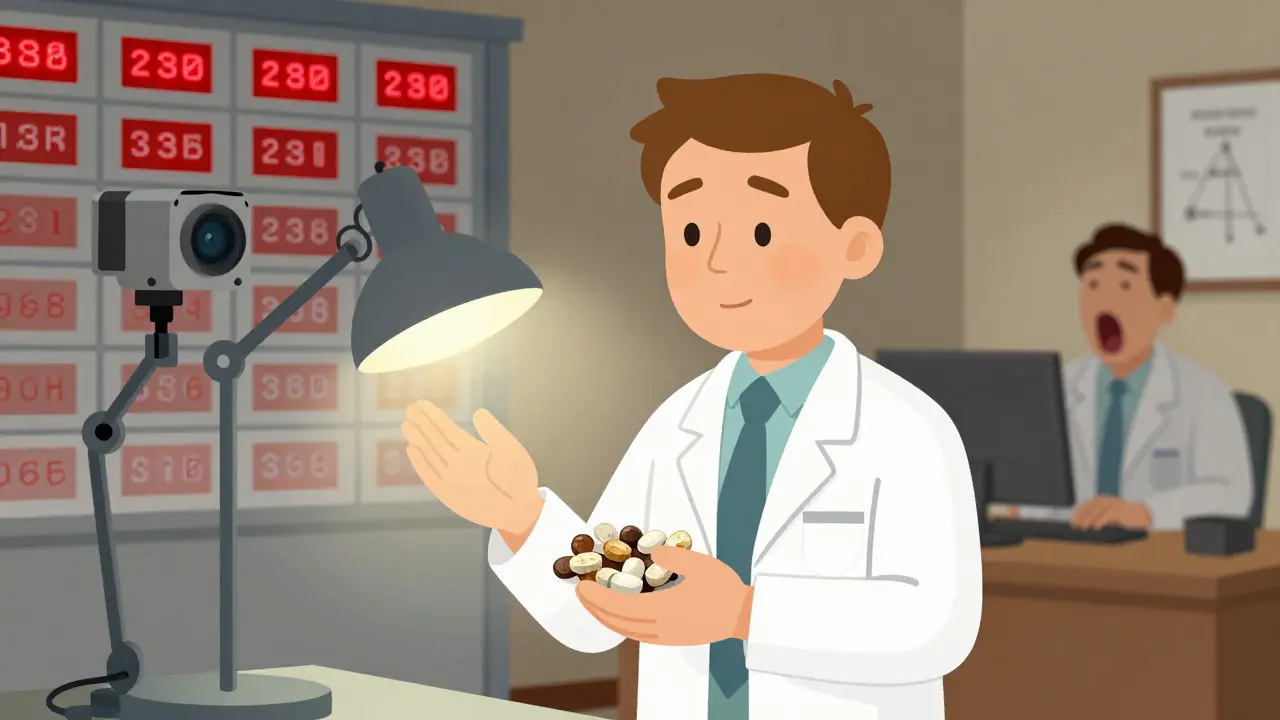

When you pick up a generic pill at the pharmacy, you expect it to work just like the brand-name version. But what if that pill is cracked, discolored, or contains too little - or too much - of the active ingredient? These aren’t rare mistakes. They’re common manufacturing flaws that happen more often in generic drugs than most people realize.
What Goes Wrong in Generic Drug Manufacturing?
Generic drugs are copies of brand-name medications. They’re supposed to be identical in strength, safety, and effectiveness. But the process of making them is far from perfect. The biggest problem isn’t the formula - it’s how they’re made. Tablets can split apart at the edges, a flaw called capping. This happens when compression pressure goes over 15 kN and the moisture content in the powder is below 2%. In hydrophobic formulations, this causes the top layer to pop off like a loose lid. It’s not just cosmetic - if the tablet breaks in your hand, you might not get the full dose. Another issue is lamination, where the tablet splits into layers. This usually occurs when tablet presses run faster than 40 rotations per minute and pre-compression isn’t strong enough. You won’t always see it, but the drug inside may dissolve too fast or too slow, changing how your body absorbs it. Then there’s sticking. When the active ingredient melts slightly under heat and pressure - especially if it has a melting point under 120°C - it clings to the metal punch heads. This slows production, causes uneven dosing, and leaves residue that can contaminate the next batch. Ejection forces spike by 300-500 N, putting extra stress on machines and increasing the chance of defects. Weight variation is another silent killer. If granules don’t flow at least 0.5 grams per second into the die, tablets will vary in weight by more than 5%. That’s outside the USP <905> limit. In 12.7% of affected batches, patients end up with inconsistent doses - some too weak, some too strong. For drugs like levothyroxine or warfarin, even a 5% difference can cause serious health effects. For injectables, the biggest threat is particulate contamination. Tiny glass fragments, rubber stopper particles, or microbial growth can get into vials during filling. These aren’t always visible to the naked eye, but they can trigger immune reactions, block blood vessels, or cause infections. Sterile injectables have an 8.7% defect rate - nearly double that of simple oral tablets.Why Are These Problems So Common in Generics?
It’s not that generic manufacturers are careless. It’s that the system pushes them to cut corners. Branded drug companies spend 15-18% of their production budget on quality control. Generic makers average just 8-10%. Why? Because they’re competing on price. A single generic tablet might sell for pennies. Profit margins are razor-thin. Investing in new equipment, better training, or real-time monitoring systems eats into those margins. The result? Outdated factories. Many generic plants still use machinery from the 1980s or 90s. These machines can’t maintain the ±0.05 mm tolerance needed for consistent tablet thickness. They don’t have real-time force sensors to detect compression deviations. They rely on manual inspections - and humans miss about 30% of defects. Shared facilities make things worse. The same line might make antibiotics one day, blood pressure meds the next, and then a steroid cream. Cross-contamination isn’t just a risk - it’s inevitable without deep, time-consuming cleanings. And many manufacturers skip full validation between runs to save time and money. The numbers don’t lie. Between 2019 and 2023, FDA inspections found that 57% of generic manufacturing sites failed compliance checks, compared to just 28% for branded facilities. In 2023, 63% of generic recalls were due to manufacturing defects - compared to 41% for branded drugs. And it’s getting worse. The European Medicines Agency reported that 37% of rejected generic applications in 2023 were due to manufacturing flaws, up from 29% in 2019.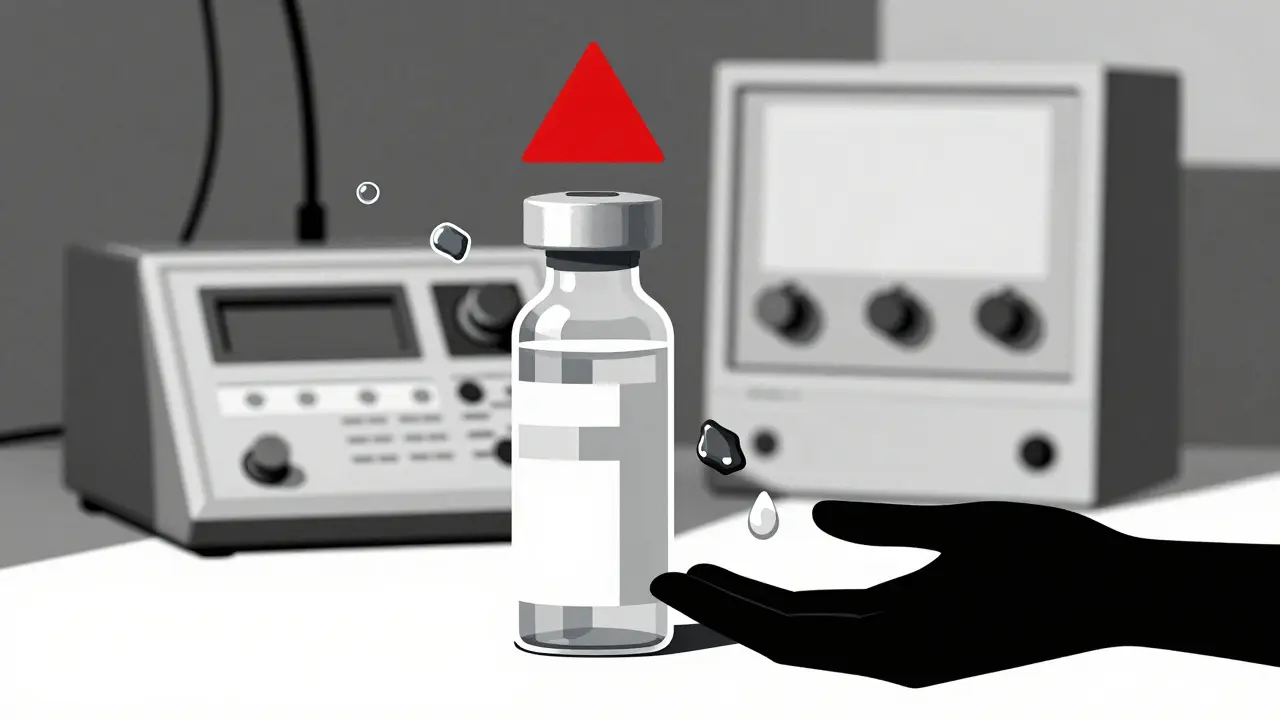
Which Generics Are Most at Risk?
Not all generics are created equal. Some are far more likely to have defects. Complex formulations are the most vulnerable. Modified-release tablets - like extended-release metformin or oxycodone - have layered coatings and special matrices to control how the drug releases over time. If the coating is uneven, or the granules aren’t compressed just right, the drug can dump all at once. That’s dangerous. One 2023 patient report described a batch of generic metformin ER that crumbled in the bottle. Patients taking it reported nausea, dizziness, and spikes in blood sugar. Inhalers are another high-risk category. They require precise metering of drug powder into aerosol form. A tiny variation in particle size or dose uniformity can mean the difference between effective relief and a life-threatening asthma attack. Defect rates for inhalers hit 18.2% - the highest of any dosage form. Even simple immediate-release tablets aren’t safe. They still have a 9.3% defect rate. Capping, weight variation, and mottling (uneven color) are common. Patients notice these. They complain. They stop taking the medication. A 2023 survey of 1,247 pharmacists found that 42% had patients report visible tablet defects - chipping, discoloration, odd shapes. And 29% said patients noticed different effects from generics, even from the same manufacturer.What’s Being Done to Fix This?
There’s progress - but it’s slow. The FDA launched its Emerging Technology Program in 2023. So far, 47 generic manufacturers have adopted continuous manufacturing - a modern process that runs nonstop, with sensors monitoring every step. These systems cut defect rates by 65% compared to old batch methods. They’re expensive to install, though. Only big players like Teva and Sandoz can afford them. Teva reported a 0.8% batch rejection rate in 2023. Smaller companies? They’re averaging 3.2%. AI-powered visual inspection is another breakthrough. Traditional systems use human inspectors or basic cameras. New AI tools can spot defects as small as 0.1 mm - like a hairline crack or a speck of dust - at 600 tablets per minute. Pilot programs at Sandoz and Dr. Reddy’s are hitting 92% detection accuracy. That’s up from 78% with older tech. The 2024 Drug Supply Chain Security Act now requires digital tracking for high-risk generics. If a batch is recalled, you can trace it back to the exact machine and shift that made it. Early results show a 22% drop in counterfeit-related issues. But here’s the catch: the Generic Pharmaceutical Association estimates it would take $28.7 billion to upgrade all U.S. generic manufacturing plants to modern standards. Right now, the industry invests just $1.2 billion a year. That’s a gap of $27.5 billion. Without serious funding, the problem won’t go away.