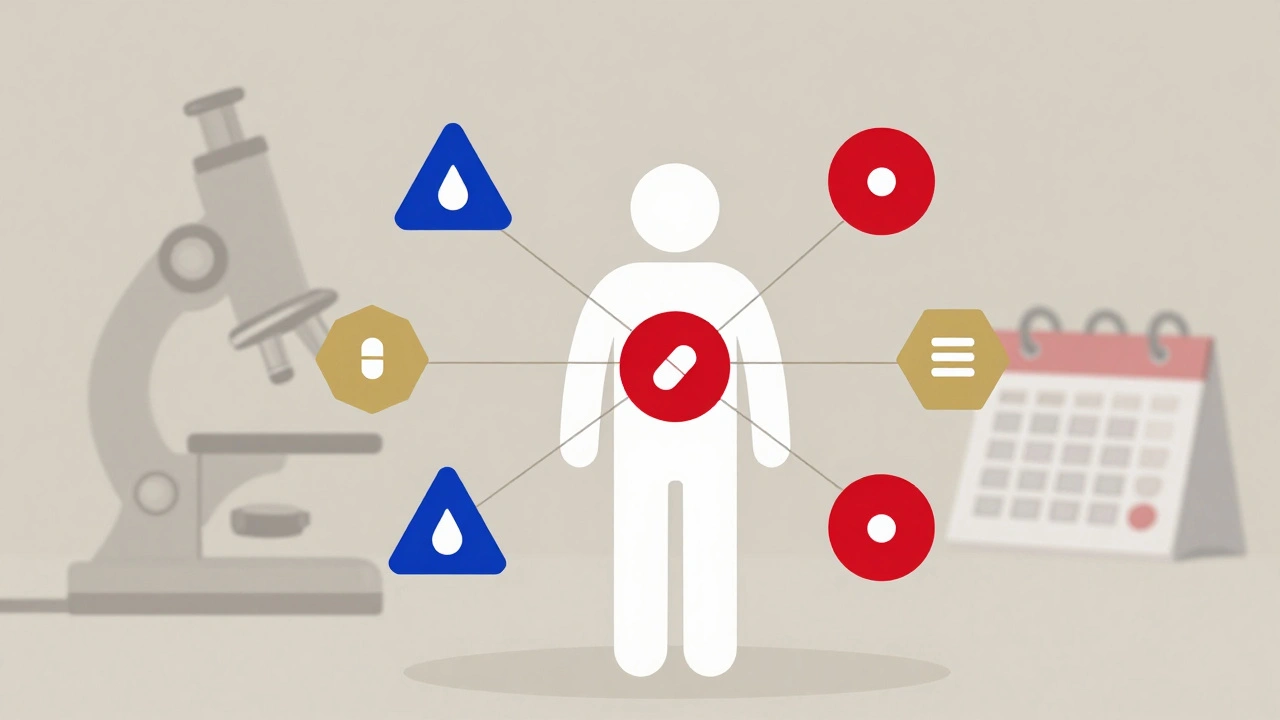
Real-World Evidence Sources for Drug Safety: Registries and Claims Data

Real-World Evidence Sources for Drug Safety: Registries and Claims Data

Drug Safety Data Source Selector

Select Your Scenario

Recommended Data Source

Key Comparison
Patient Registry
  • 87% lab value completeness
  • Cost: $1.2M-$2.5M startup
  • Best for rare diseases
Claims Data
  • 52% lab value completeness
  • Cost: Low (existing systems)
  • Best for large populations

When a new drug hits the market, the real test of safety doesn’t happen in a controlled clinical trial. It happens in the messy, real world-where millions of people take it daily, with different diets, other medications, genetic backgrounds, and lifestyles. That’s where real-world evidence comes in. Two of the most powerful tools for tracking drug safety after approval are patient registries and claims data. Together, they give regulators, doctors, and drugmakers a clearer picture of what’s really happening out there-beyond the 6-month study window of a typical trial.

What Exactly Is Real-World Evidence?

Real-world evidence (RWE) isn’t guesswork. It’s data pulled from everyday healthcare systems: doctor visits, hospital stays, pharmacy fills, lab results, and even patient self-reports. The U.S. Food and Drug Administration (FDA) officially defined it in 2018 as clinical evidence derived from real-world data (RWD)-information collected outside of randomized trials. Since then, RWE has gone from a niche tool to a core part of drug safety monitoring. Between 2017 and 2021, the FDA approved 12 new drug uses where RWE played a decisive role. Five of those approvals relied directly on claims data or registry records.

Registries: The Deep Dive into Patient Stories

Think of registries as detailed medical diaries for specific groups of patients. Disease registries track people with conditions like cystic fibrosis, Parkinson’s, or rare cancers. Product registries follow patients using a specific drug or device. These aren’t random surveys-they’re structured, long-term collections of standardized information.

For example, the Cystic Fibrosis Foundation Patient Registry helped spot safety signals for ivacaftor, a drug that works only for certain genetic mutations. In clinical trials, those mutations were too rare to notice any unusual side effects. But in the registry, with over 30,000 patients tracked over years, patterns emerged. That’s the power of depth.

Registries capture things claims data often misses: lab values, imaging results, patient-reported symptoms, and detailed treatment histories. According to ISPOR, registry data has 87% completeness for lab results, compared to just 52% in claims data. That’s why they’re especially valuable for rare diseases or complex conditions where small changes matter.

But registries aren’t perfect. They’re expensive to run-often costing $1.2 to $2.5 million to launch and $300,000 to $600,000 a year to maintain. Participation rates hover between 60% and 80%, which can introduce selection bias. And nearly one in three academic registries shut down within five years due to funding gaps. Still, when they’re well-run, they’re among the most trusted sources for regulatory decisions.

Claims Data: The Big Picture from Billing Records

Claims data is what happens behind the scenes when a doctor bills an insurance company. It’s not clinical notes-it’s codes: ICD-10 for diagnoses, CPT for procedures, NDC for medications. It’s dry, but it’s massive. IBM MarketScan tracks 200 million lives. Optum covers 100 million. Medicare claims alone span 15+ years of data for millions of elderly patients.

This scale makes claims data perfect for spotting rare side effects. If a drug causes a heart rhythm problem in 1 in 10,000 people, you need huge numbers to see it. In 2015, the FDA analyzed 1.2 million Medicare beneficiaries to check if entacapone increased cardiovascular risk. They found no link. In 2014, they used 850,000 records to study olmesartan in diabetics-again, finding no clear danger.

Claims data is also incredibly complete for basic healthcare use. Inpatient care is tracked at 95-98% accuracy. That’s why it’s the go-to for tracking hospitalizations, ER visits, or medication adherence after a drug launches.

But here’s the catch: claims data doesn’t tell you why a patient was hospitalized. Was it the drug? An infection? A fall? It lacks clinical context. Lab values are only 45-60% complete. Patient-reported symptoms? Almost never there. And diagnosis codes can be wrong-up to 20% error rates, according to AHRQ. That’s why many signals from claims data turn out to be false alarms.

A data grid of medical codes with a doctor examining a safety signal among millions of claims.

Registries vs. Claims Data: When to Use Which

| Feature | Registries | Claims Data | |--------|------------|-------------| | Data Depth | High: labs, imaging, symptoms | Low: mostly codes and billing info | | Population Size | 1,000-50,000 patients | 100 million+ patients | | Longitudinal Coverage | 5-15 years (if funded) | 15+ years (Medicare) | | Completeness of Lab Values | 87% | 52% | | Rare Event Detection | Needs ~500,000 records | Needs ~1 million records | | Cost to Build | $1.2M-$2.5M upfront | Low (uses existing systems) | | Best For | Rare diseases, complex outcomes, long-term safety | Large populations, hospitalizations, medication use | For oncology drugs, registries dominate-38% of RWE submissions use them. That’s because cancer treatments are complex, and outcomes like progression-free survival or quality of life need detailed tracking. In cardiovascular drugs, claims data leads at 45% of submissions. Why? Because heart attacks, strokes, and hospital readmissions are well-coded in billing systems.

The smartest approach? Use both. The International Council for Harmonisation (ICH) E2 proposal from June 2023 says combining the two reduces false positive safety signals by 40%. A claim shows a spike in liver enzyme reports. A registry confirms those patients had no other liver disease, were on the same dose, and had matching lab results. That’s how you move from suspicion to certainty.

Real-World Evidence in Action: Success Stories

In 2017, the FDA approved an expanded use of pembrolizumab (Keytruda) based on registry data from an expanded access program. Patients outside clinical trials were getting the drug, and their outcomes were recorded in real time. That data helped confirm it worked in more patient groups than originally tested.

In 2021, the European Medicines Agency approved a new use for tacrolimus (a transplant drug) using data from the Scientific Registry of Transplant Patients. That registry tracked outcomes for over 100,000 transplant recipients-something no trial could ever replicate.

And in 2019, palbociclib’s approval for a new patient group relied on claims data, electronic health records, and safety reports. The FDA needed to know if it was safe for older patients with multiple health problems. Claims data showed no increased risk of blood clots or hospitalizations in that group-enabling a broader label.

A balanced scale comparing detailed patient registries and billing data in modernist style.

Challenges and Pitfalls

Even with all this progress, RWE isn’t magic. Claims data can be misleading. A 2022 study in JAMA Internal Medicine found that 22% of initial safety signals from claims data alone were false positives-meaning the drug wasn’t actually to blame. That’s why clinical adjudication is critical. A doctor has to review the actual medical record to confirm the event.

Registries struggle with sustainability. Many are funded by grants or academic institutions. When funding runs out, so does the data. The NIH found that 35% of academic registries disappear within five years.

There’s also the issue of bias. People who join registries are often more engaged, healthier, or have better access to care. That doesn’t reflect the general population. Claims data misses people without insurance, undocumented patients, or those who pay out of pocket.

And then there’s the technical side. Integrating claims data into pharmacovigilance systems takes 6-9 months. You need data scientists who understand ICD-10, CPT, and NDC codes-not just statistics. The FDA’s Sentinel Initiative, which connects 11 health systems and 3 claims processors, is one of the few successful large-scale models. It monitors safety for over 300 million patients.

The Future: AI, Wearables, and Standardization

The next wave of RWE is faster, smarter, and more connected. In 2023, Novartis began combining claims data with wearable sensor readings to monitor heart failure patients on Entresto. The wearables tracked heart rate variability and fluid levels-data no claims system could capture.

AI is helping too. A 2024 study in JAMA Network Open showed AI-powered signal detection cut false positives by 28%. Instead of flagging every spike in kidney injury reports, the algorithm learned which patterns were likely real.

The FDA’s REAL program, launched in September 2023, aims to standardize registry data for 20 priority diseases by 2026. The first focus? Rare diseases. Why? Because traditional trials can’t enroll enough patients to detect safety signals. Registries are the only way.

Meanwhile, the European Medicines Agency’s Darwin EU network now covers 120 million EU citizens across 23 national databases. That’s bigger than the population of Spain. And it’s growing.

Why This Matters to You

Whether you’re a patient, a doctor, or just someone who takes medication, this matters. Real-world evidence keeps drugs safer after they’re on the shelf. It catches problems clinical trials miss-like a rare interaction with a common over-the-counter painkiller, or a side effect that only shows up after five years of use.

It also means faster approvals for new uses. A drug approved for breast cancer might get a new label for lung cancer based on registry data-without waiting years for another trial.

The goal isn’t to replace clinical trials. It’s to complete them. Trials tell us what happens under ideal conditions. Registries and claims data tell us what happens when the real world gets involved. Together, they’re the best tool we have to protect public health.

Comments: (12)

Jade Hovet
Jade Hovet

December 14, 2025 AT 07:43

OMG this is SO important!! šŸ™Œ I had no idea registries could catch side effects that trials miss... like that ivacaftor thing?? Mind blown. 🤯 We need MORE of this, not less!!

nithin Kuntumadugu
nithin Kuntumadugu

December 16, 2025 AT 01:06

LMAO they call this 'science'? šŸ˜‚ Registries? Claims data? Please. Big Pharma paid for 80% of this 'data'. The FDA's just another puppet. Wake up sheeple. šŸ¤–šŸ’‰ #PharmaControl

Harriet Wollaston
Harriet Wollaston

December 16, 2025 AT 06:07

This made me feel so much better about my meds. I always worry about the long-term stuff, but knowing there are people quietly tracking this stuff? Feels like a safety net. šŸ’› Thanks for sharing this clearly!

Lauren Scrima
Lauren Scrima

December 17, 2025 AT 16:46

So... you're telling me we spent $2.5M to track 30k patients... but we can get 100M+ from billing codes? And the billing codes are wrong 20% of the time? šŸ¤” So... we're paying millions to avoid... paying millions? šŸ˜…

sharon soila
sharon soila

December 18, 2025 AT 22:14

Every life matters. Every data point is a person. When we choose to listen to real-world stories, not just lab results, we honor the dignity of those who take these medicines every day. This isn't just science. It's compassion in action.

nina nakamura
nina nakamura

December 19, 2025 AT 12:44

Registries are a waste. Claims data is garbage. You think the FDA cares? They're just rubber stamping whatever Big Pharma feeds them. 22% false positives? That's not noise. That's fraud. And you're all drinking the Kool-Aid.

Constantine Vigderman

December 19, 2025 AT 13:41

Wait wait wait-so wearables + AI + claims data? That’s wild. Imagine your smartwatch flags an odd heart rhythm, and the system cross-checks it with your pharmacy fills and EHRs? That’s next-level. šŸ¤–ā¤ļø We’re not just monitoring drugs anymore-we’re monitoring PEOPLE.

Cole Newman
Cole Newman

December 20, 2025 AT 10:31

Yo so like... if claims data is so trash why does the FDA even use it? And why do we pay for it? Just sayin'-this whole thing feels like a giant bureaucratic loop. Someone’s getting paid to make this complicated.

Casey Mellish
Casey Mellish

December 21, 2025 AT 15:22

Australia’s adopting Darwin EU’s model right now. It’s brilliant. We’ve got 25 million people, and we’re connecting Medicare, PBS, and hospital systems. No more silos. No more guesswork. Just clean, longitudinal, real-world signals. This is the future-and it’s already here.

Emily Haworth
Emily Haworth

December 23, 2025 AT 00:55

What if the registries are being manipulated? What if the patients who join are the ones who already had bad reactions? And what if the claims data is being altered to hide deaths? I’ve seen things... I can’t say more... but the system is rigged.

Tom Zerkoff
Tom Zerkoff

December 24, 2025 AT 10:18

I’ve worked in pharmacovigilance for 18 years. This post nails it. Registries and claims data aren’t perfect-but together? They’re the only thing keeping us from blind spots the size of a city. Don’t let the cynics scare you. This is how we save lives.

Bruno Janssen
Bruno Janssen

December 24, 2025 AT 11:43

I just read this. I’m tired. I don’t care anymore. I just take my pills. Someone else can figure it out.

Write a comment

Your email address will not be published. Required fields are marked *