
Every year, millions of people in the U.S. pay hundreds of dollars for prescriptions they could get for under $10. Not because they don’t know better, but because they’ve been told brand-name drugs are somehow better. That’s not true. Generic medications are not cheaper because they’re weaker-they’re cheaper because they don’t carry the marketing bill.
They’re the exact same medicine
When you take a generic drug like atorvastatin, you’re getting the same active ingredient as Lipitor. Same chemical structure. Same dose. Same way your body absorbs it. The U.S. Food and Drug Administration (FDA) doesn’t allow generics on the market unless they match the brand-name drug in every way that matters: how fast it enters your bloodstream, how much of it gets there, and how long it stays active.
The FDA requires bioequivalence testing-meaning the generic must deliver between 80% and 125% of the brand’s concentration in your blood. That’s not a guess. That’s science. And it’s not just for simple pills. Even complex drugs like blood thinners and seizure medications must meet this standard. If a generic doesn’t pass, it doesn’t get sold.
What’s different? The color. The shape. The filler ingredients. Maybe the logo on the pill. Those don’t affect how the drug works. They’re just there so the generic doesn’t look exactly like the brand. That’s a trademark rule, not a safety rule.
They save you money-big time
Let’s say you’re on warfarin. The brand-name version, Coumadin, can cost over $300 for a 30-day supply. The generic? Around $4. That’s a 98% drop. Same pill. Same effect. Same risk. Just a fraction of the price.
Or take fexofenadine, the generic for Allegra. Brand: $30. Generic: $10. Metformin for diabetes? Glucophage costs $300/month. Generic? $4. That’s not a bargain. That’s a lifeline.
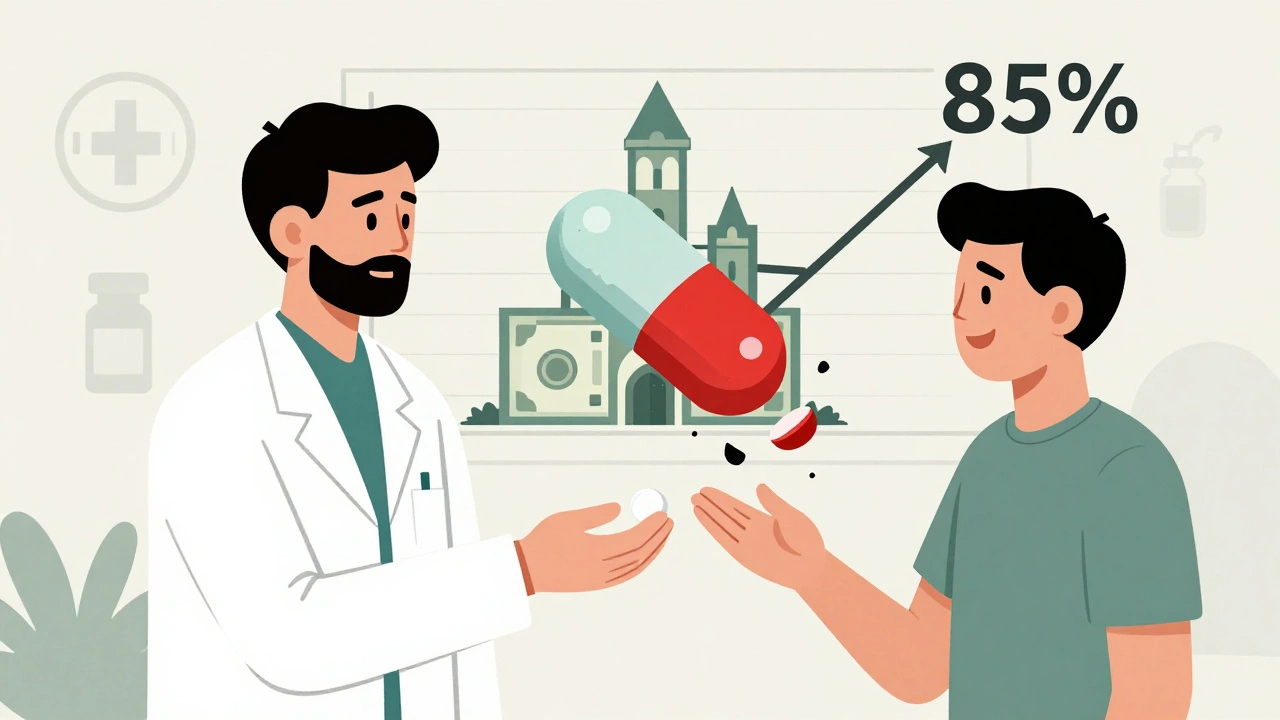
According to the FDA, generics cost, on average, 85% less than brand-name drugs. In markets where five or more companies make the same generic, prices drop nearly 85% compared to the original. When Lipitor went generic in 2011, its price fell from $130 a month to as low as $4. That’s not inflation. That’s competition.
Over the past decade, generic drugs saved the U.S. healthcare system over $1.6 trillion. That’s not a number from a press release. That’s real money pulled out of patients’ pockets and insurance premiums. And it’s still growing.
They’re just as safe
Some people worry: “If it’s cheaper, is it less safe?” The data says no. The FDA inspects generic manufacturing facilities just as often as brand-name ones-over 1,200 inspections a year. The same standards. Same rules. Same quality checks.
Adverse event reports for generics? They match their usage rate. Since generics make up 90% of prescriptions, they also make up 90% of reports. That doesn’t mean they’re dangerous. It means they’re widely used-and monitored.
A 2022 study in the Journal of Managed Care & Specialty Pharmacy looked at over 186,000 patients on heart medications. Half took generics. Half took brand names. No difference in heart attacks, strokes, or deaths. Another study in the Journal of the American Heart Association found the same results. Your blood pressure won’t spike because you switched to generic lisinopril. Your cholesterol won’t climb because you took simvastatin instead of Zocor.
Even in high-stakes cases-like epilepsy or thyroid meds-the FDA says approved generics are safe. Yes, some doctors express caution with narrow therapeutic index drugs. But that’s not because generics are unreliable. It’s because those drugs require tight control. And even then, the generic versions that pass FDA review are just as stable.
Doctors and insurers want you to switch
Your doctor isn’t hiding something. They’re probably already prescribing generics when they can. The American Medical Association recommends it. The CDC encourages it. Hospitals and pharmacies? 99% of them prioritize generics.
Insurance plans push generics too. Humana’s 2023 data shows average copays: $1-$10 for generics. $25-$75 for brand names. Some plans won’t cover the brand unless you prove the generic doesn’t work for you. That’s not a trick. It’s cost control that benefits you.
Pharmacists are trained to explain the switch. When your prescription is filled with a different-looking pill, they’re supposed to tell you: “This is the same drug. Just cheaper.” If they don’t, ask. You have the right to know.
People are already switching-and they’re happy
On Reddit, a user named PharmTech87 wrote: “Switching my blood pressure meds to generic saved me $280 a month. No side effects. No issues.” Kaiser Permanente’s 2023 survey found 87% of members were satisfied with generics, mostly because they could afford them.
One diabetes patient on PatientsLikeMe said: “Metformin generics cost me $4/month versus $300 for Glucophage. This keeps me adherent to my treatment.” That’s the real win. When drugs are affordable, people take them. When they’re not, people skip doses. The FDA says patients on generics are 68% less likely to skip their meds because of cost.
That’s not just savings. That’s better health.
What about biosimilars? Are they the next step?
Yes. Biosimilars are the generic version of complex biologic drugs-like those for rheumatoid arthritis, cancer, or diabetes. They’re harder to copy than a simple pill. But they’re coming. As of December 2023, the FDA had approved 37 biosimilars. They’re already saving billions. The Congressional Budget Office estimates they’ll save $300 billion over the next decade.
And they’re not science fiction. They’re here. And they’ll follow the same rules: same effectiveness, lower price.
When you shouldn’t switch (and why)
There are almost no cases where you shouldn’t switch. But if you’ve been on a brand-name drug for years and feel perfectly stable, there’s no rush. Some people do better with consistency. If your doctor says, “Stick with this one,” listen.
But don’t assume your current drug is the only option. Ask: “Is there a generic?” Even if you’re fine now, switching could save you hundreds-or thousands-over time.
The only real reason not to switch? Fear of change. Not science. Not safety. Just anxiety over a pill that looks different.
How to make the switch
- Ask your doctor: “Is there a generic version of this drug?”
- Ask your pharmacist: “Is this the generic? Can you confirm it’s the same?”
- Check the FDA’s Orange Book online-it lists all approved generics and their brand equivalents.
- If your insurance won’t cover the generic, ask them why. Sometimes it’s just a formality.
- Don’t panic if the pill looks different. That’s normal. Call your pharmacist if you’re unsure.
Switching doesn’t require a new prescription. Often, your pharmacist can swap it automatically unless your doctor says “dispense as written.”
Bottom line
Generic medications aren’t a compromise. They’re the standard. The same medicine. The same results. The same safety. Just a fraction of the cost. Every time you choose a generic, you’re not just saving money. You’re keeping your treatment affordable, consistent, and sustainable.
There’s no reason to pay more unless you have a specific, documented reason to do so. And even then, it’s worth asking: ‘Why?’


