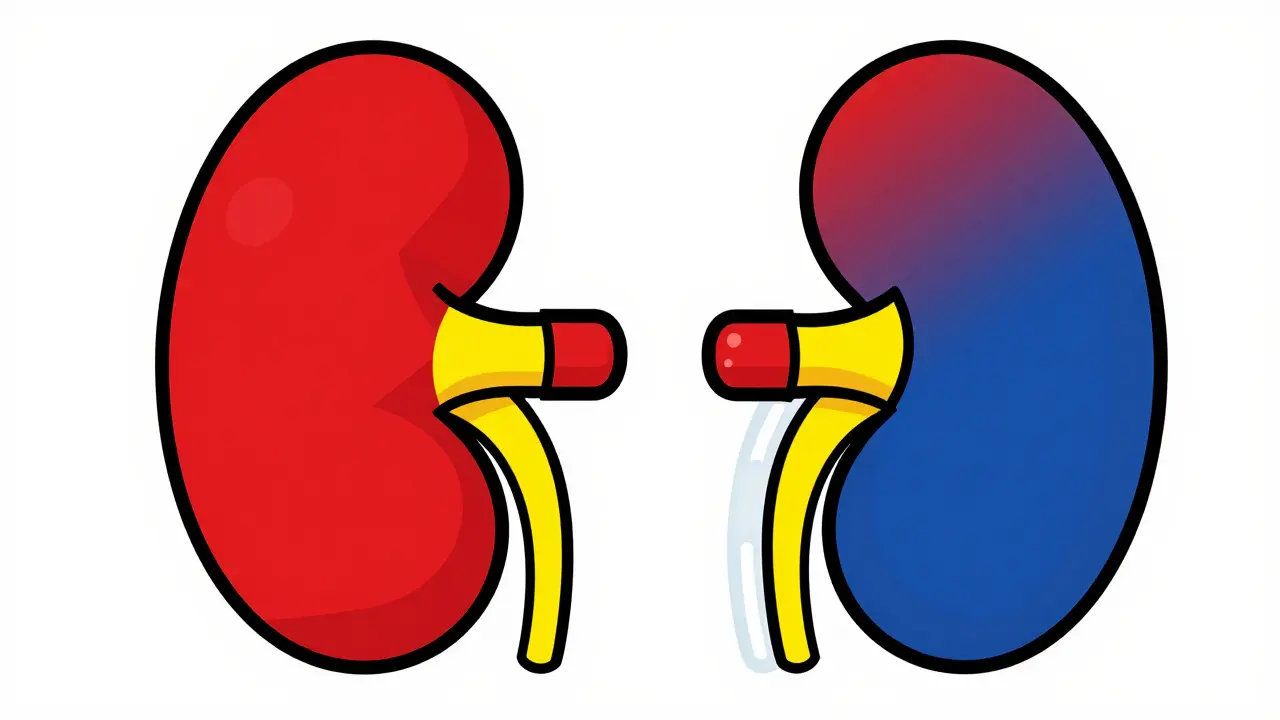

Your kidneys are hardworking filters that clean your blood around the clock. But sometimes, they stop working suddenly. This condition is called Acute Kidney Injury, or AKI. It isn't the same as chronic kidney disease, which develops slowly over years. AKI happens fast-within hours or days. If you don't catch it early, it can become life-threatening. The good news? Many people recover fully if they get help quickly.
What Is Acute Kidney Injury?
Acute Kidney Injury (AKI) is a rapid decline in kidney function that occurs within hours to days. Doctors used to call this "acute renal failure," but the name changed because even mild drops in function matter. According to the KDIGO guidelines established in 2012, AKI is defined by a rise in serum creatinine levels or a drop in urine output. Creatinine is a waste product from muscle wear and tear. Healthy kidneys filter it out. When levels spike, your kidneys aren't doing their job.
This condition affects about 13.3 million people worldwide each year. In hospitals, up to 30% of patients in intensive care units develop AKI. For critically ill patients, the mortality rate sits between 24% and 37%. That’s why early detection saves lives.
Recognizing the Signs: Symptoms of AKI
The tricky part about AKI is that symptoms vary wildly. Some people feel terrible; others feel fine until tests reveal the problem. Here’s what to watch for:
- Low urine output: Producing less than 400 mL per day (oliguria) or less than 100 mL (anuria). However, some people still pee normally despite serious injury.
- Swelling: Fluid retention causes puffiness in legs, ankles, or hands. About 68% of cases show peripheral edema.
- Breathing issues: Shortness of breath occurs in 42% of hospitalized patients due to fluid building up in the lungs (pulmonary edema).
- Fatigue and confusion: Feeling exhausted happens in 75% of cases. Confusion or altered mental status affects one-third of elderly patients.
- Nausea and pain: Up to 58% experience nausea. Flank pain (between ribs and hips) appears in 27% of intrarenal cases.
Critically, 22% of AKI cases have no obvious symptoms at all. They’re only found through routine blood work. If you’re high-risk-like having heart disease or diabetes-regular check-ups are non-negotiable.
Why Does It Happen? Three Main Causes
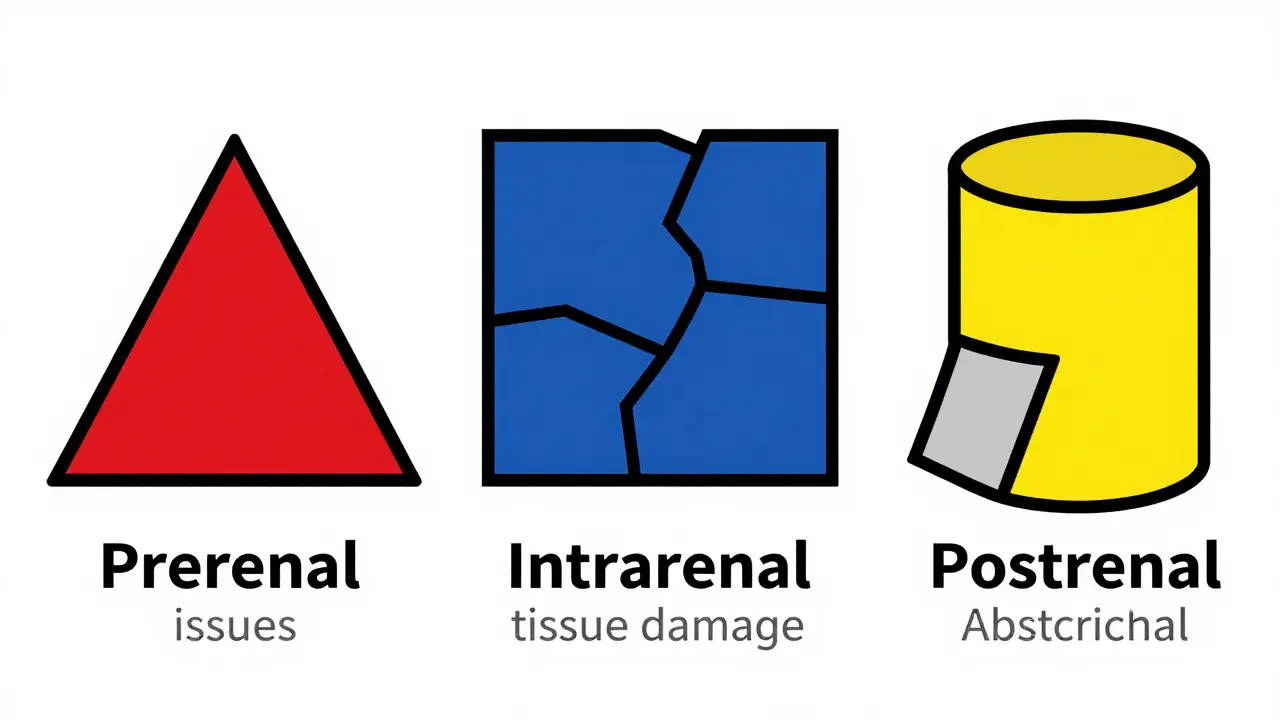
Doctors categorize AKI into three types based on where the problem starts. Understanding the cause dictates the treatment.
| Type | Prevalence | Primary Cause | Common Triggers |
|---|---|---|---|
| Prerenal AKI | 60-70% | Reduced blood flow to kidneys | Severe dehydration, hemorrhage, heart failure |
| Intrarenal AKI | 25-35% | Direct damage to kidney tissue | Toxic drugs, infections, glomerulonephritis |
| Postrenal AKI | 5-10% | Urinary tract obstruction | Enlarged prostate, kidney stones, tumors |
Prerenal AKI is the most common. It happens when your kidneys don’t get enough blood. Think severe dehydration from vomiting, major bleeding, or low blood pressure lasting more than an hour. Heart failure alone causes 25% of hospital-acquired AKI cases.
Intrarenal AKI means the kidney tissue itself is damaged. Acute tubular necrosis (ATN) accounts for 45% of these cases. Nephrotoxic medications like certain antibiotics (aminoglycosides) or IV contrast dyes used in scans can trigger this. Systemic diseases like lupus also play a role.
Postrenal AKI is a plumbing issue. Something blocks urine flow. In men over 60, benign prostatic hyperplasia (enlarged prostate) causes 65% of obstructive cases. Kidney stones account for 20%. If urine backs up, pressure damages the kidneys.
Diagnosis: How Doctors Confirm AKI
You won’t guess if you have AKI. You need lab tests. The gold standard is the KDIGO staging system. Doctors look for two main markers:
- Serum Creatinine: An increase of ≥0.3 mg/dL within 48 hours, OR a ≥50% increase from your baseline within 7 days.
- Urine Output: Less than 0.5 mL/kg/hour for six consecutive hours.
Staging helps determine severity:
- Stage 1 (Mild): Creatinine 1.5-1.9x baseline.
- Stage 2 (Moderate): Creatinine 2.0-2.9x baseline.
- Stage 3 (Severe): Creatinine ≥3x baseline or ≥4.0 mg/dL, often requiring dialysis.
Imaging is crucial too. A renal ultrasound is used in 85% of evaluations to check for blockages or structural changes. CT scans detect kidney stones with 95% sensitivity. Blood tests also check for electrolyte imbalances, like high potassium (hyperkalemia), which can stop your heart if untreated.
Treatment Strategies: Fixing the Problem
Treatment depends entirely on the cause. There is no single "AKI pill."
For prerenal AKI, the fix is usually fluids. Doctors give 500-1000 mL boluses of normal saline. If caught early, 70% of these cases resolve within 24-48 hours. Stop the bleeding, treat the heart failure, or rehydrate, and the kidneys often bounce back.
For intrarenal AKI, you must remove the insult. If a drug caused it, stopping that medication leads to improvement in 65% of cases within 72 hours. If it’s an autoimmune attack like glomerulonephritis, immunosuppressants or corticosteroids may induce remission in 50-70% of patients.
For postrenal AKI, you need to unclog the pipe. Placing a ureteral stent or catheter relieves obstruction immediately in 90% of cases. Once the blockage is gone, the kidneys can drain and heal.
In severe cases where toxins build up dangerously, Renal Replacement Therapy (RRT) becomes necessary. This includes hemodialysis or continuous renal replacement therapy (CRRT). About 5-10% of hospitalized AKI patients need intermittent hemodialysis. ICU patients might use CRRT, which runs continuously to gently filter blood. Peritoneal dialysis is rare (2-5%) but used when vascular access is difficult.

Recovery and Long-Term Outlook
Will your kidneys fully recover? It depends. Prerenal AKI has the best prognosis. With prompt treatment, 70-80% of patients regain full function within 7-10 days. Intrarenal AKI takes longer-partial or complete recovery happens over 2-6 weeks in 40-60% of cases. Severe acute tubular necrosis with prolonged low urine output (>14 days) has a tougher road; only 20-30% achieve full functional recovery.
Several factors predict poorer outcomes:
- Age: Patients over 65 have a 35% lower recovery rate.
- Prior Kidney Health: If your baseline eGFR was already below 60 mL/min/1.73m², recovery probability drops by 50%.
- Duration: AKI lasting longer than 7 days increases the risk of incomplete recovery by 2.3 times.
- Dialysis Need: Only 25% of patients requiring dialysis achieve full recovery at three months.
Even if you recover, AKI leaves a mark. About 23% of survivors develop chronic kidney disease (CKD) stage 3 or higher within one year. Each episode of AKI increases the five-year risk of end-stage renal disease by 8.2-fold. This is why follow-up care is critical. Nearly half of AKI survivors need a nephrology consult within six months of discharge.
Living with AKI: The Human Side
Medical stats don’t capture the exhaustion. A 2022 survey by the American Kidney Fund found that 68% of survivors experienced "kidney fatigue" lasting three to six months after recovery. Another 42% reported persistent anxiety about their kidney function. Many struggle with reduced exercise tolerance, requiring temporary disability accommodations.
One patient, "DialysisDad42," shared his story online: "After my AKI from sepsis, I spent 17 days in ICU on CRRT. Even after my creatinine normalized, I couldn't walk more than 50 feet without exhaustion for three months. The mental toll of thinking I might need permanent dialysis was worse than the physical symptoms."
But there is hope. Another user, "HealthyKidneys88," described a swift recovery: "Caught my AKI from dehydration at stage 1. Two liters of IV fluids in ER, creatinine back to normal in 24 hours. Full recovery in 5 days with no long-term issues." Timing is everything.
Prevention and Early Detection
Can you prevent AKI? Often, yes. The key is protecting your kidneys during vulnerable moments.
- Stay Hydrated: Especially if you have diarrhea, vomiting, or fever. Dehydration is a top trigger for prerenal AKI.
- Review Medications: Tell every doctor about all drugs and supplements you take. NSAIDs (like ibuprofen) and certain antibiotics can stress kidneys.
- Monitor During Illness: If you’re hospitalized, ask for regular creatinine checks. Electronic health record "alerts" have reduced AKI mortality by 12% in academic centers by flagging risks early.
- Know Your Baseline: If you have existing kidney issues, know your normal creatinine and eGFR numbers. Changes matter more than absolute values.
New technology is helping too. Biomarkers like NGAL (neutrophil gelatinase-associated lipocalin) can predict AKI 24-48 hours before creatinine rises. Trials using AI algorithms to analyze hospital data aim to predict AKI risk with 75% accuracy, allowing preemptive interventions that could cut incidence by 20-30%.
Is acute kidney injury reversible?
Yes, in many cases. Prerenal AKI is often fully reversible with fluid resuscitation and treating the underlying cause. Intrarenal AKI may partially or fully recover over weeks, depending on the extent of tissue damage. However, severe cases involving prolonged dialysis or advanced age have lower rates of complete recovery, and some patients progress to chronic kidney disease.
What are the first signs of acute kidney failure?
Early signs include decreased urine output, swelling in extremities, shortness of breath, fatigue, nausea, and confusion. However, up to 22% of cases present with no obvious symptoms, making regular blood tests essential for high-risk individuals.
How long does it take to recover from AKI?
Recovery time varies by type and severity. Prerenal AKI often resolves within 24-48 hours with treatment. Intrarenal AKI may take 2-6 weeks for partial or full recovery. Severe cases requiring dialysis may take months, and some never return to baseline function.
Can dehydration cause acute kidney injury?
Yes. Severe dehydration reduces blood flow to the kidneys, leading to prerenal AKI. This accounts for 15-20% of community-acquired AKI cases. Prompt rehydration can reverse this type of injury quickly.
Does AKI lead to chronic kidney disease?
It can. About 23% of AKI survivors develop stage 3 or higher chronic kidney disease within one year. Each episode of AKI significantly increases the long-term risk of end-stage renal disease, highlighting the need for ongoing monitoring after recovery.