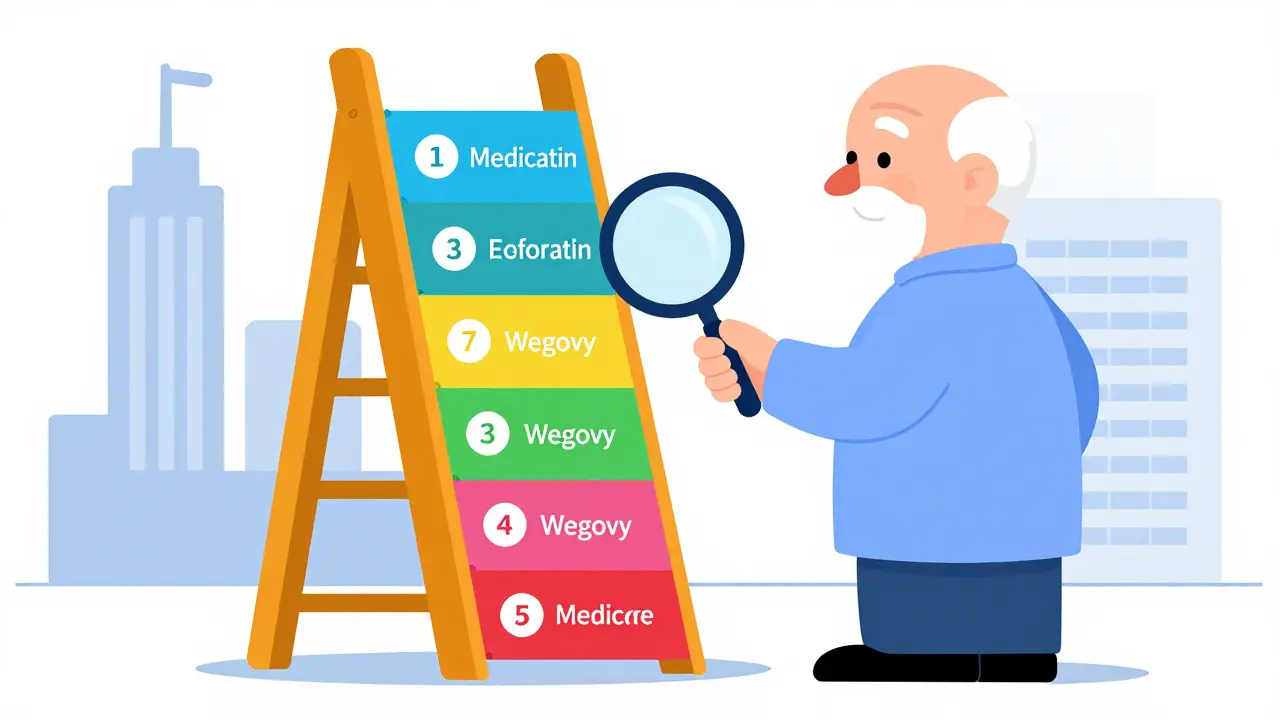

When you're on Medicare Part D, your prescription drug coverage isn't set in stone. Every year, and sometimes even in the middle of the year, your plan can change which drugs it covers and how much you pay for them. This is called a formulary change. If you take medications regularly - especially for conditions like diabetes, high blood pressure, or weight management - these changes can hit your wallet hard. One month, your blood pressure pill costs $10. The next, it's $55. That’s not a mistake. It’s a tier shift. And if you don’t know how to check for these changes, you’re flying blind.
What Is a Drug Formulary and Why Do Tiers Matter?
A drug formulary is simply the list of medications your insurance plan covers. But it’s not just a list. It’s broken into tiers, and each tier means a different price for you. Think of it like a pricing ladder. The lower the tier, the less you pay. The higher the tier, the more you pay - sometimes a lot more.
Most Medicare Part D plans use a 4-tier or 5-tier system:
- Tier 1: Preferred generics - usually under $10 per prescription.
- Tier 2: Non-preferred generics or lower-cost brand-name drugs - around $15-$30.
- Tier 3: Higher-cost brand-name drugs - often $40-$80.
- Tier 4: Specialty drugs - these can cost $100 or more per month. Think GLP-1 weight loss drugs like Wegovy or Ozempic.
Some plans even have a Tier 5 for the most expensive specialty medications. The key thing to understand: the same drug can be on different tiers across different plans. Your neighbor’s plan might cover your medication in Tier 1, but yours puts it in Tier 3. That’s why you can’t assume your coverage stays the same - even if you’ve been on the same plan for years.
When Do Formulary Changes Happen?
You might think your drug list is locked in for the year. It’s not. Plans can update their formularies anytime - but there are rules.
Most changes happen on January 1st, when new plan years begin. But insurers can also make changes during the year if:
- A new generic version of your drug becomes available.
- New safety data comes out about a medication.
- A drug is no longer considered effective.
- A new, more expensive drug enters the market - like a GLP-1 weight loss medication - and the plan moves it into a higher tier.
According to CMS guidelines, if a change affects a drug you’re currently taking, your plan must notify you in writing at least 60 days before the change takes effect - unless it’s a safety issue. In those cases, they can act faster. But here’s the catch: many seniors don’t read these notices. Or they get buried in mail. That’s why waiting for a letter is risky.
In 2023, about 17% of all formulary changes involved moving a drug to a higher tier - meaning higher out-of-pocket costs. And it’s not just generics being replaced. Weight loss drugs like Wegovy are being moved into Tier 4 or even Tier 5, sometimes overnight. One user on Medicare.gov reported their monthly cost for a GLP-1 drug jumped from $25 to $180 without warning. That’s not uncommon.
How to Check Your Drug Coverage - Step by Step
You don’t need to wait for a notice. You can check your coverage yourself - and you should do it every fall and every time you refill a prescription.
- Find your plan’s formulary tool. Go to your insurance provider’s website. Look for “Drug List,” “Formulary,” or “Find a Medication.” For example, if you’re with Humana, Cigna, or Excellus BCBS, these tools are easy to find under “Medicare” or “Prescription Drug Coverage.”
- Search for each medication you take. Type in the exact name - brand or generic. Don’t guess. If you take metformin, search for “metformin,” not “diabetes pill.”
- Check the tier and cost. The tool will show you the tier (Tier 1, 2, etc.) and your copay or coinsurance. Write it down. Compare it to last year’s cost.
- Look for alternatives. If your drug is on a high tier, the tool may suggest a similar drug in a lower tier. Ask your doctor: “Is there another option that’s covered better?” Sometimes switching to a different generic or brand can save you hundreds.
- Check for prior authorization. Some drugs require your doctor to get approval before the plan will cover them. If you see “Prior Authorization Required,” call your pharmacy or plan. Don’t assume it’s automatic.
Most tools update on January 1st, but they reflect mid-year changes too. If you’re unsure, call your plan’s customer service. They’re required to answer questions about coverage - and they’re available 24/7 under Medicare rules.
What to Do If Your Drug Gets Moved to a Higher Tier
If you find out your medication is now more expensive, you have options. Don’t just pay more. Fight back.
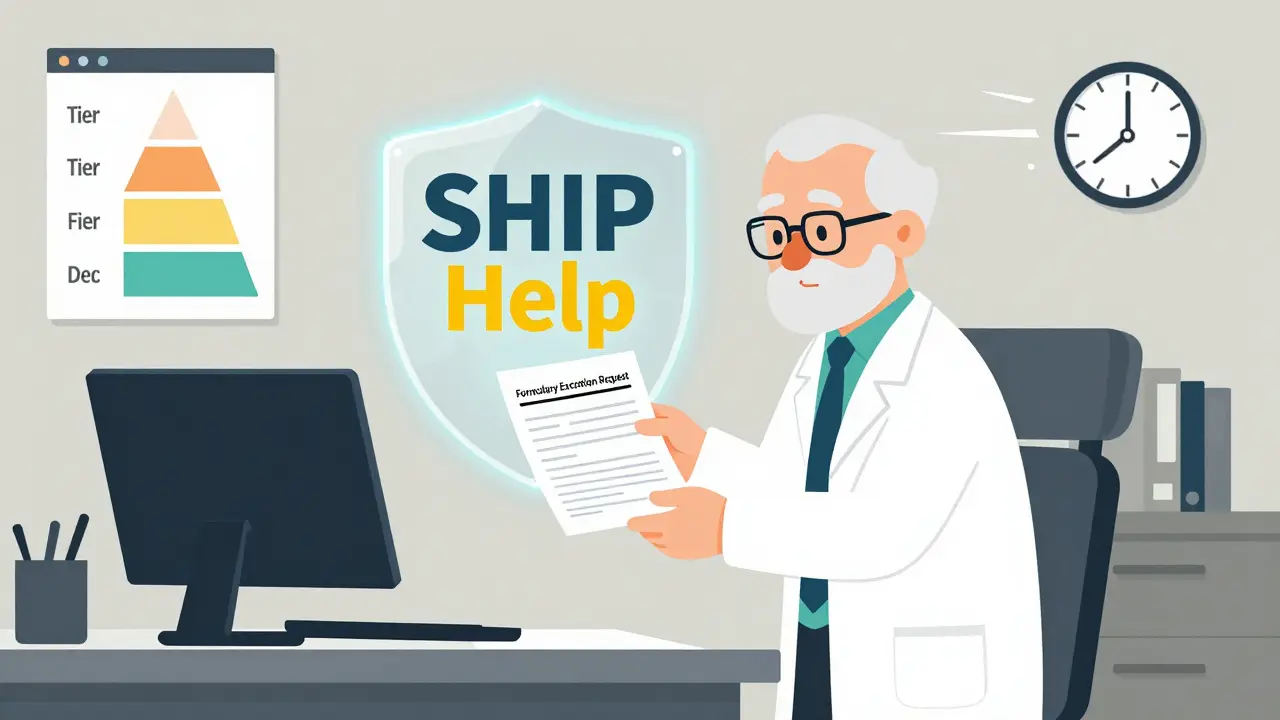
- Request a formulary exception. This is your right. You can ask your plan to cover your drug at a lower cost if it’s medically necessary. Your doctor fills out a short form explaining why you need this specific drug - maybe because others caused side effects or didn’t work. Approval rates vary, but 55% to 82% of requests are approved, depending on the plan and the evidence.
- Use a 30-day transition supply. If your drug is being removed or moved, your plan must give you at least a 30-day supply at the old price. Use that time to work on an exception or switch medications.
- Ask your pharmacist. Pharmacists know the formulary better than most. They can tell you if there’s a cheaper alternative you haven’t considered. Many will even call your doctor on your behalf.
- Use free help. Every state has a SHIP (State Health Insurance Assistance Program). These are free, unbiased counselors who help seniors navigate Medicare. In 2022, they helped over 1.7 million people with formulary questions. Find yours at shiphelp.org.
One user in Bristol told us: “I didn’t know I could ask for an exception. I was paying $60 a month for my heart medication. After my doctor submitted the request, it went back to $10. I wish I’d known sooner.”
Common Mistakes Seniors Make
Here are the top three mistakes that lead to surprise costs:
- Not checking until you get to the pharmacy. You think your drug is covered - until the cash register says otherwise. Always check before you refill.
- Assuming last year’s formulary still applies. Plans change. Your drug might have been on Tier 1 last year. This year, it’s Tier 3. You need to verify every fall.
- Ignoring the fine print. If your plan says “prior authorization required,” and you don’t get it, you pay full price. No exceptions.
And here’s something most people don’t realize: the same drug can be covered differently in different plans. So if you’re thinking about switching plans during Open Enrollment (October 15-December 7), compare formularies - not just premiums. A plan with a slightly higher premium might save you $300 a year on meds.
What’s Changing in 2025 and Beyond?
Things are getting more complex - but also more transparent.
By 2025, CMS plans to standardize formulary tiers across Medicare Part D plans, moving toward a clearer 4-tier system. That means less confusion. But here’s the catch: more specialty drugs are being added. By 2026, over half of the top-selling drugs will be in the highest tier. That includes not just weight loss drugs, but also treatments for multiple sclerosis, rare cancers, and autoimmune diseases.
Insurers are also rolling out AI tools that predict which drugs will move tiers based on market trends. By 2025, 78% of plans will use these systems to update formularies faster. That’s good for the insurer - but not always good for you. The faster the change, the less time you have to react.
The bottom line: your formulary isn’t static. It’s dynamic. And if you don’t stay on top of it, you’ll pay the price.
Quick Checklist: Your Formulary Action Plan
- ✅ Check your formulary every October before Open Enrollment.
- ✅ Search every medication you take - brand and generic.
- ✅ Note the tier and cost for each drug.
- ✅ Ask your pharmacist for alternatives if a drug is expensive.
- ✅ Call your plan if you see a change you didn’t expect.
- ✅ File a formulary exception if your drug is moved to a higher tier.
- ✅ Use SHIP for free, personalized help - no cost, no sales pitch.
If you take even one prescription, this isn’t optional. It’s your money. And you have the right to know what you’re paying for - and how to pay less.
How often should I check my drug coverage?
You should check your drug coverage at least once a year, right before Medicare Open Enrollment (October 15-December 7). But if you take medications that are expensive or frequently change tiers - like GLP-1 drugs for weight loss or blood pressure medications - check every time you refill your prescription. Formulary changes can happen mid-year, and your plan is required to notify you, but many seniors miss those notices. Don’t wait for a letter. Check online.
Can my plan drop a drug I’m taking?
Yes, but they can’t just remove it without notice. If your drug is being removed from the formulary or has new restrictions added, your plan must give you at least 60 days’ written notice - unless it’s due to a safety issue. Even then, they must provide a 30-day supply at the old cost while you work out a solution. You can also request a formulary exception if the drug is medically necessary. Many plans approve these requests, especially if your doctor explains why alternatives won’t work.
Why is my drug suddenly more expensive?
Your drug likely moved to a higher tier. This happens when a new generic becomes available, a drug is deemed less effective, or a new, more expensive alternative enters the market. For example, many GLP-1 weight loss drugs like Wegovy were moved into Tier 4 or 5 in 2024 and 2025, increasing costs from $20 to over $150 per month. If you’re seeing a big price jump, check your plan’s formulary tool. If the tier changed, you can request an exception or ask your doctor for a covered alternative.
Do all Medicare Part D plans have the same drug tiers?
No. Each plan designs its own formulary, so the same drug can be on different tiers across different plans. For example, metformin might be in Tier 1 with one plan and Tier 2 with another. That’s why comparing formularies during Open Enrollment is critical. A plan with a slightly higher premium might save you hundreds on meds. Use Medicare’s Plan Finder tool or talk to a SHIP counselor to compare coverage side by side.
What if I can’t afford my medication after a tier change?
You have several options. First, request a formulary exception - your doctor can submit a form explaining why you need this specific drug. Second, ask your pharmacist about lower-cost alternatives. Third, use the 30-day transition supply your plan must provide. Fourth, apply for Extra Help through Medicare - a program that lowers costs for low-income beneficiaries. Finally, contact your State Health Insurance Assistance Program (SHIP). They offer free, personalized help and have helped over 1.7 million seniors in 2022. Don’t skip doses because of cost. There are always options.