
Imagine spending weeks preparing a case, only to have your motion to switch lawyers stricken from the record because you used a state court form in a federal building. It sounds like a nightmare, but for many attorneys, it's a costly reality. The gap between how state and federal courts handle the replacement of legal counsel is wider than most people realize, and the stakes are high. A simple procedural slip-up isn't just an embarrassment-it can lead to malpractice claims or a client being left without representation at a critical moment.
The Core Conflict: Rigor vs. Autonomy
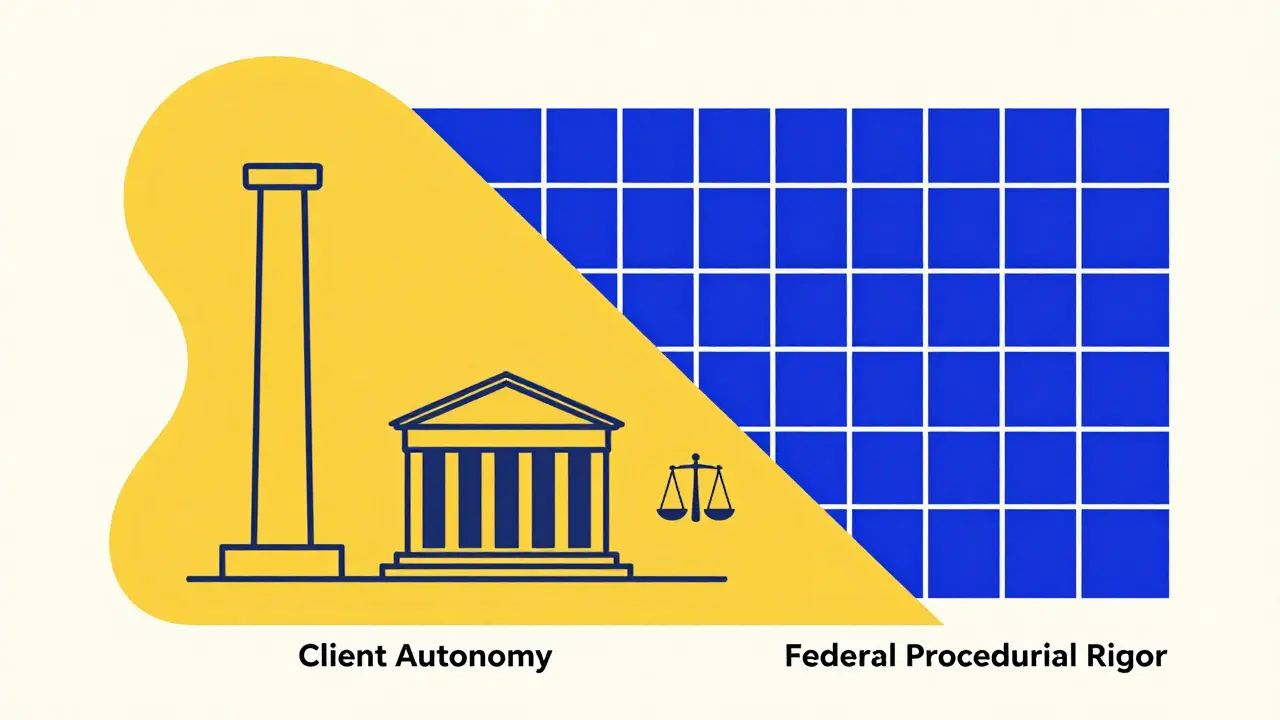
At its heart, the conflict between state and federal substitution rules is a clash of philosophies. Federal courts are obsessed with procedural rigor. They want to ensure that changing lawyers doesn't slow down the wheels of justice or provide a tactical excuse for a party to delay a trial. On the other hand, most state courts prioritize client autonomy. They believe that if a client wants to fire their lawyer and hire someone else, the court shouldn't stand in the way.
This tension is rooted in the Tenth Amendment, which reserves powers to the states, and the Supremacy Clause, which ensures federal law takes precedence in federal venues. This means that even if you are in a state like Florida, where the Florida Supreme Court Rule 4-1.16(c) gives clients an almost absolute right to change attorneys via a simple signed form, those rules vanish the moment you step into a federal district court.
Federal Rules: The High Bar for Entry
In the federal system, you can't just "swap" lawyers. The Federal Rules of Civil Procedure, specifically Rule 83, demand a formal process. You need a motion signed by the client, the outgoing attorney, and the incoming attorney. Crucially, the court must approve the change, even if the lawyers are from the same firm.
Some districts are even stricter. In the Eastern District of New York, Local Rule 1.09 requires letter motions to magistrate judges. If you try to slide in a last-minute substitution, you're facing a tougher road; data from the U.S. Courts Administrative Office shows only a 70% approval rate for these urgent requests. Furthermore, in specialized venues like federal tax courts, Rule 83.12 requires the new lawyer to prove their standing before the Internal Revenue Service. It's a high-friction process designed to keep the docket moving.
| Feature | Federal Courts (FRCP) | Common State Practice (e.g., CA, TX, NY) |
|---|---|---|
| Court Approval | Mandatory for all substitutions | Often consensual (no court sign-off needed) |
| Justification | Detailed reasons often required | Usually no explanation needed |
| Same-Firm Changes | Requires formal motion/approval | Typically handled internally/informally |
| Notice Period | Stricter (e.g., 14 days in E.D. Penn) | More flexible (e.g., 7 days in New Jersey) |

State Systems: A Patchwork of Flexibility
State courts are generally much more relaxed, but the real danger for lawyers is the lack of consistency. While 32 states-including heavyweights like California and Texas-allow substitutions without court approval, the "how" varies by county. In Texas, for example, Harris County demands everything be filed electronically, while Brewster County might still insist on a piece of paper and a stamp.
This flexibility can be a double-edged sword. While it's easier to switch counsel, the lack of a uniform standard means attorneys practicing across state lines are constantly guessing. This is why 17% of malpractice claims in 2023 involved improper substitution procedures; lawyers simply assumed the rules in one jurisdiction applied to another.
The Danger Zone: Last-Minute Changes
The most volatile time to substitute counsel is right before a trial. Federal judges have very little patience for "lawyer shopping" or tactical delays. The Second Circuit Court of Appeals famously rejected 31% of substitution motions filed within 30 days of a trial in the 2023 case Smith v. Johnson. They view these late requests as attempts to undermine judicial efficiency.
Contrast that with California's state courts, where 89% of similarly timed motions are approved. If an attorney moves from a California state practice to a federal practice, they might assume a last-minute switch is a formality, only to find themselves in a heated battle with a federal judge who views the request as a tactical maneuver.

Practical Survival Guide for Multi-Jurisdictional Practice
If you're operating in both worlds, you can't rely on memory. The learning curve for transitioning between these systems is typically 6 to 12 months. To avoid the $8,500 mistake-like the one reported by attorney Mark Reynolds in Chicago-you need a system of checks and balances.
First, never assume a "standard form" exists. Use a dual-template system. The American Immigration Lawyers Association saw a 47% drop in errors after implementing specific templates for state and federal filings. Second, check the local rules of the specific district. While the FRCP provides the baseline, the Central District of California might require an e-signature while the District of Columbia still wants "wet ink."
Pro tips for a smooth transition:
- Audit the Local Rules: Always check the specific district's local rules (e.g., Local Rule 5.3(c) in D.C.) before filing.
- Over-Document: In federal court, provide more justification than you think is necessary. Explain the new attorney's specific expertise to satisfy the court's concern about case disruption.
- Verify Standing: If you're in a specialized court (like Tax Court), verify the substitute's credentials with the relevant agency first.
- Timeline Buffer: Aim to file substitution motions at least 30 days before any major deadline to avoid the "tactical delay" scrutiny.
The Future: Moving Toward Harmonization
The legal industry is starting to realize that this fragmentation is too expensive. The RAND Institute for Civil Justice predicts that without changes, substitution errors could cost the system $417 million annually by 2030. We are seeing a slow shift toward alignment. The Conference of Chief Justices approved a model rule in 2024 to align state practices with federal standards, though adoption has been slow.
The most promising lead is the Uniform Law Commission's draft "Interjurisdictional Legal Practice Act," expected in late 2025. If passed, it could finally create a common language for substitutions, meaning a lawyer wouldn't have to wonder if their motion is "too simple" for a federal judge or "too formal" for a state court.
Can a client fire their lawyer in federal court without the court's permission?
While a client generally has the right to terminate their attorney-client relationship, the actual substitution of a new lawyer in an active federal case requires a formal motion and court approval under FRCP 83. The court can deny the substitution if it believes the change will unfairly delay the proceedings, though they cannot usually force a client to keep a lawyer they no longer trust.
What happens if I file a state substitution form in a federal court?
The motion will likely be stricken from the record for failing to comply with the Federal Rules of Civil Procedure. This can lead to wasted legal fees and, in worst-case scenarios, a gap in representation that could jeopardize the client's case or lead to missed deadlines.
Do I need a motion to change lawyers if they are in the same law firm?
In federal court, yes. Even for same-firm substitutions, a formal motion and court approval are required. In many state courts, however, this can be handled internally or through a much simpler notification process.
Why are federal courts more likely to reject last-minute substitutions?
Federal courts prioritize docket efficiency and are wary of "tactical substitutions"-where a party switches lawyers right before trial to seek a continuance or delay the case. Consequently, they apply much stricter scrutiny to the timing and reasoning of the request.
Are there any tools to help prevent substitution errors?
Yes, legal practice management software now offers jurisdictional compliance modules (like those from Clio) that alert attorneys to the specific rules of the venue they are filing in. Additionally, the Federal Judicial Center provides a Substitution of Counsel Checklist to help lawyers meet all requirements.


