QT Prolongation Risk Calculator
Patient Risk Assessment
Enter patient information to calculate Torsades de Pointes risk
Risk Assessment Result
Important: This tool estimates risk based on clinical factors described in the article. It is not a substitute for medical judgment.
Enter patient information to see results
Every year, hundreds of people in the U.S. and Europe suffer a sudden, terrifying heart rhythm called torsades de pointes - and most had no idea they were at risk. It doesn’t come with warning signs like chest pain or dizziness. One moment, a patient feels fine. The next, their heart starts twisting out of control. This isn’t a rare genetic disorder. It’s often caused by everyday medications people take for common conditions: infections, depression, nausea, or even chronic pain. The good news? Torsades de pointes is almost always preventable - if you know what to look for.
What Exactly Is Torsades de Pointes?
Torsades de pointes (TdP) is a dangerous type of irregular heartbeat that shows up on an ECG as a twisting pattern of QRS complexes around the baseline. It’s not just any arrhythmia - it’s a specific, life-threatening rhythm that only happens when the heart’s electrical reset time - the QT interval - gets too long. Think of it like a delayed reaction in the heart’s wiring. After each beat, the heart needs time to recharge. If that recharge time stretches too far, extra electrical signals can fire off randomly, triggering this chaotic rhythm. It doesn’t always cause symptoms. Some people feel nothing until they collapse. Others might have palpitations, lightheadedness, or fainting. But when TdP doesn’t stop on its own, it can flip into ventricular fibrillation - a rhythm that stops blood flow entirely. About 10% to 20% of cases end in sudden death if not treated immediately.How Do Medications Cause This?
More than 200 commonly used drugs can prolong the QT interval. They don’t all do it the same way, but most interfere with a key potassium channel in heart cells called hERG. This channel helps the heart reset after beating. Block it, and the heart takes longer to recharge. The longer the recharge, the higher the chance of TdP. Some of the worst offenders aren’t heart drugs at all. Take antibiotics: erythromycin and clarithromycin (macrolides), and moxifloxacin (a fluoroquinolone) are all linked to TdP. Antifungals like ketoconazole and voriconazole carry risk too. Even common anti-nausea drugs like ondansetron and dolasetron can trigger it - especially at high doses. Antidepressants? Citalopram and escitalopram have clear warnings: don’t exceed 40 mg per day, and cut that to 20 mg if you’re over 65. And then there’s methadone. Used for pain and addiction, it’s one of the most common causes of drug-induced TdP. The risk spikes when doses go above 100 mg per day. Many patients get prescribed methadone without ever having an ECG - and that’s where things go wrong.Who’s Most at Risk?
It’s not just about the drug. It’s about the person taking it. Over 87% of TdP cases involve at least one modifiable risk factor. Here’s who’s most vulnerable:- Women: They make up 70% of cases, even though men and women have similar QT prolongation rates. Why? Hormonal differences and slower drug clearance.
- People over 65: 68% of TdP cases occur in older adults. Aging slows kidney and liver function, so drugs build up.
- Low potassium or magnesium: Potassium under 3.5 mmol/L triples the risk. Magnesium under 1.6 mg/dL increases it nearly threefold. These are easy to fix - but often overlooked.
- Slow heart rate: If your heart beats under 60 times per minute, you’re at higher risk. Bradycardia gives the heart more time to develop abnormal signals.
- Multiple QT-prolonging drugs: Taking two or more of these drugs together raises the risk by 28%. A patient on citalopram, ondansetron, and azithromycin? That’s a perfect storm.
- Heart disease or kidney/liver problems: If your heart is already weak, or your body can’t clear drugs, even low doses become dangerous.

How to Prevent It - The 5-Step Approach
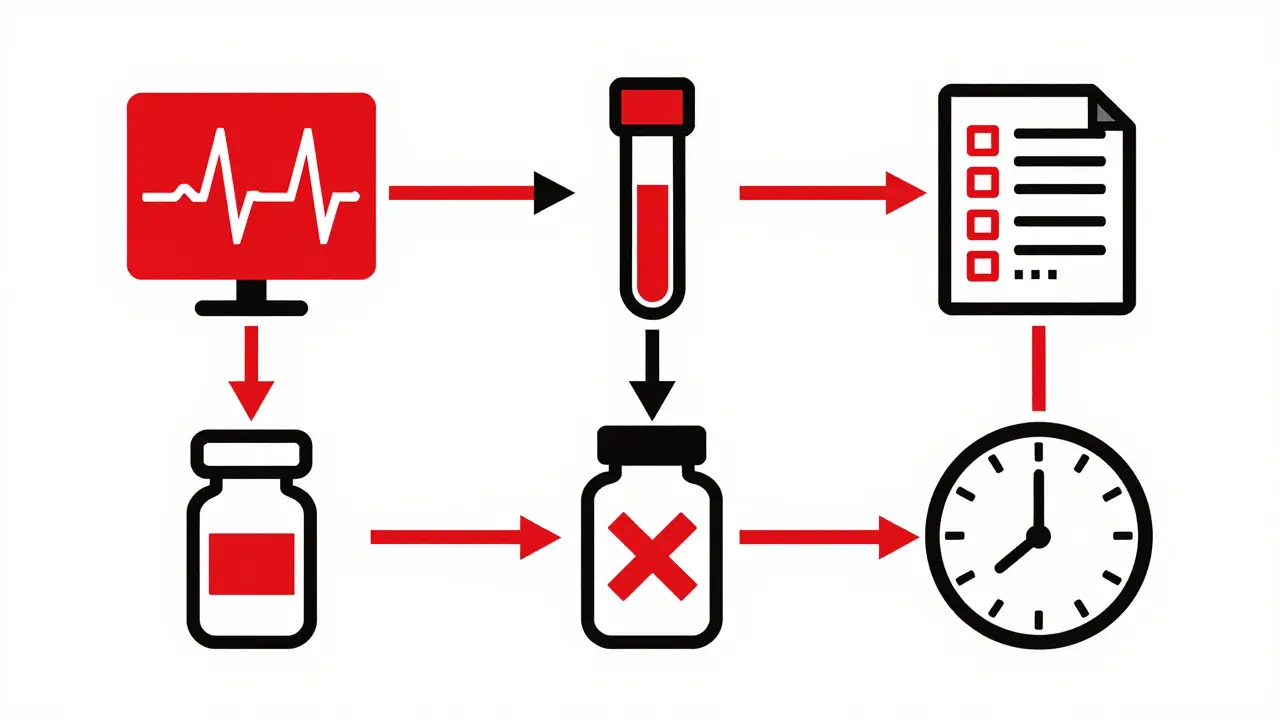
Preventing TdP isn’t about avoiding all risky drugs. It’s about smart, step-by-step risk management. Here’s what works:- Screen for inherited long QT syndrome. Use the Schwartz score - a simple tool that looks at family history, ECG patterns, and symptoms. If someone has a score over 3.5, they’re at high genetic risk.
- Check electrolytes. Before prescribing any QT-prolonging drug, test potassium and magnesium. If levels are low, correct them first. Don’t just assume they’re fine.
- Review every medication. Use CredibleMeds.org - a free, publicly available database that classifies drugs by TdP risk: “Known Risk,” “Possible Risk,” or “Conditional Risk.” If a patient is on a “Known Risk” drug, ask: Is this absolutely necessary?
- Get a baseline ECG. Measure the QTc (corrected QT interval). A QTc over 450 ms in men or 460 ms in women is prolonged. If it’s over 500 ms, avoid starting the drug. If it’s already borderline, monitor closely.
- Set up a monitoring plan. For high-risk drugs like methadone or citalopram, schedule repeat ECGs. For methadone, check at initiation and again if the dose goes above 100 mg/day. For ondansetron, avoid IV doses over 16 mg.
What to Do in an Emergency
If TdP happens - and the patient is unstable - act fast. The first-line treatment is simple: magnesium sulfate. Give 1-2 grams IV. It works in 82% of cases, even if magnesium levels are normal. Why? It stabilizes the heart’s electrical activity directly. Next, try to speed up the heart. A temporary pacemaker set to 90+ beats per minute can stop TdP by shortening the QT interval. If that’s not available, isoproterenol (a heart stimulant) can be used as a bridge. Never use defibrillation unless the rhythm turns into ventricular fibrillation. Shocking TdP can make it worse. Also: correct potassium. Keep it above 4.0 mmol/L. Stop all QT-prolonging drugs immediately. And never restart them unless the benefit clearly outweighs the risk - and only after careful reassessment.